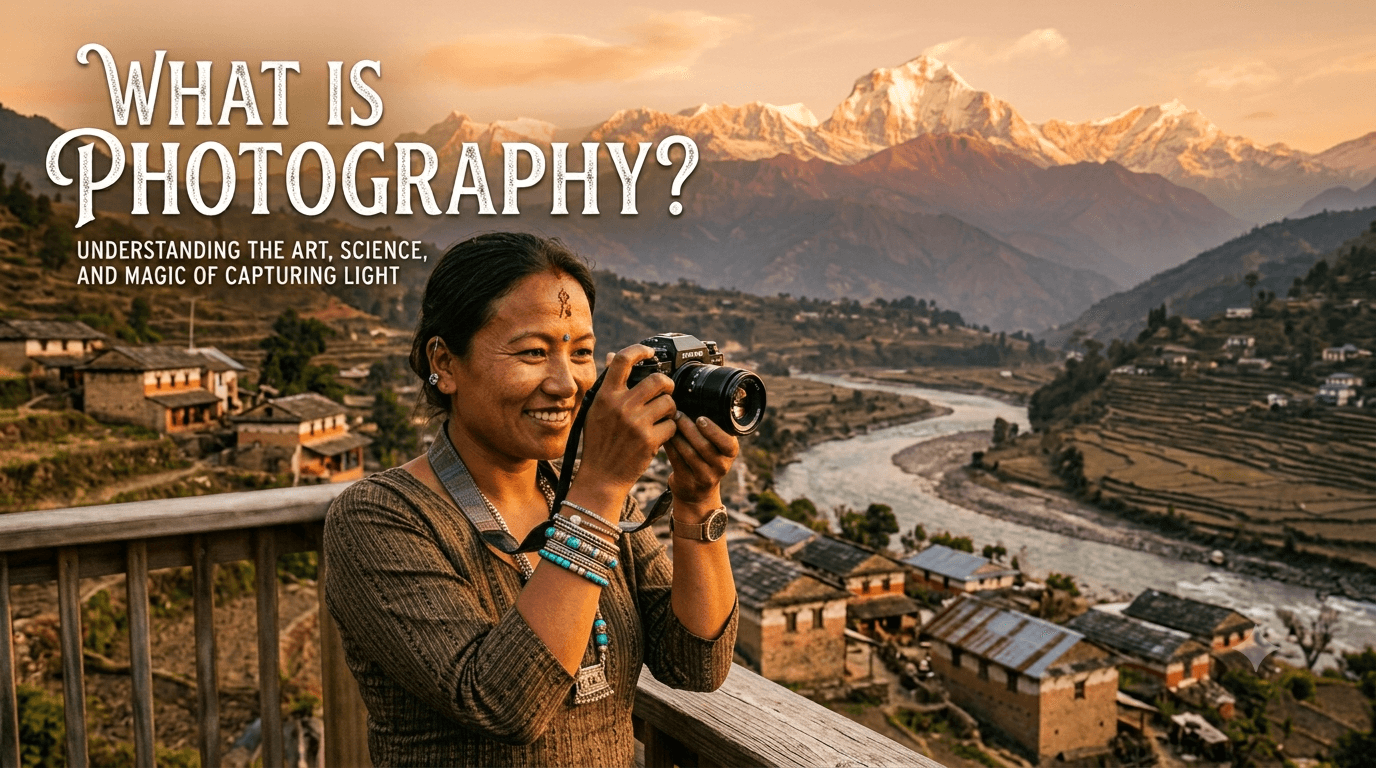
What Is Photography? Understanding Light, Camera & Image Before You Touch a Camera
Every student who walks into Zyamaru Films Academy in Tahachal asks some version of the same question in their first class: "Sir, where do I even start?"
The instinct is to start with the camera — buttons, dials, modes. But that's actually step two. Step one is understanding what a camera is even doing when you press the shutter. Once that clicks, everything else — aperture, shutter speed, ISO, composition — stops feeling like memorization and starts feeling like common sense.
This is Module 1 of our beginner-to-advanced photography roadmap. No camera in hand yet. Just the idea.
Photography is just "writing with light"
The word photography comes from Greek: photos (light) and graphé (drawing or writing). That's literally what it means — drawing with light.
Here's the simplest way to think about it: a photograph is a record of light bouncing off a subject, traveling through a lens, and landing on a surface that can capture it — film in the old days, a digital sensor now.
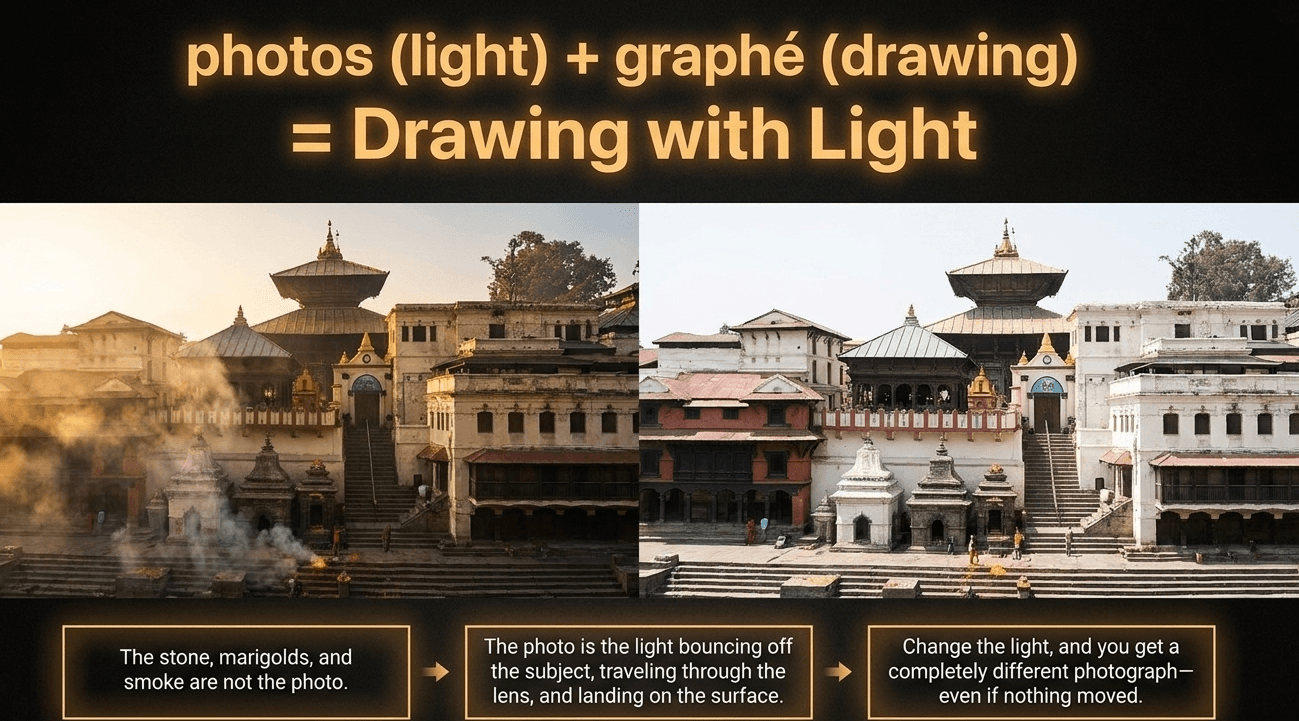
Think about Pashupatinath temple at 6 AM. The stone, the marigolds, the smoke from the ghats — none of that is "the photo." What makes the photo is the light hitting all of it and reflecting into your lens at a particular angle, a particular color temperature, a particular intensity. Change the light — shoot the same scene at noon instead of sunrise — and you get a completely different photograph, even though nothing else moved.
This is why cinematographers obsess over light more than gear. The camera is just the tool that catches it.
Four things happen every time you take a photo
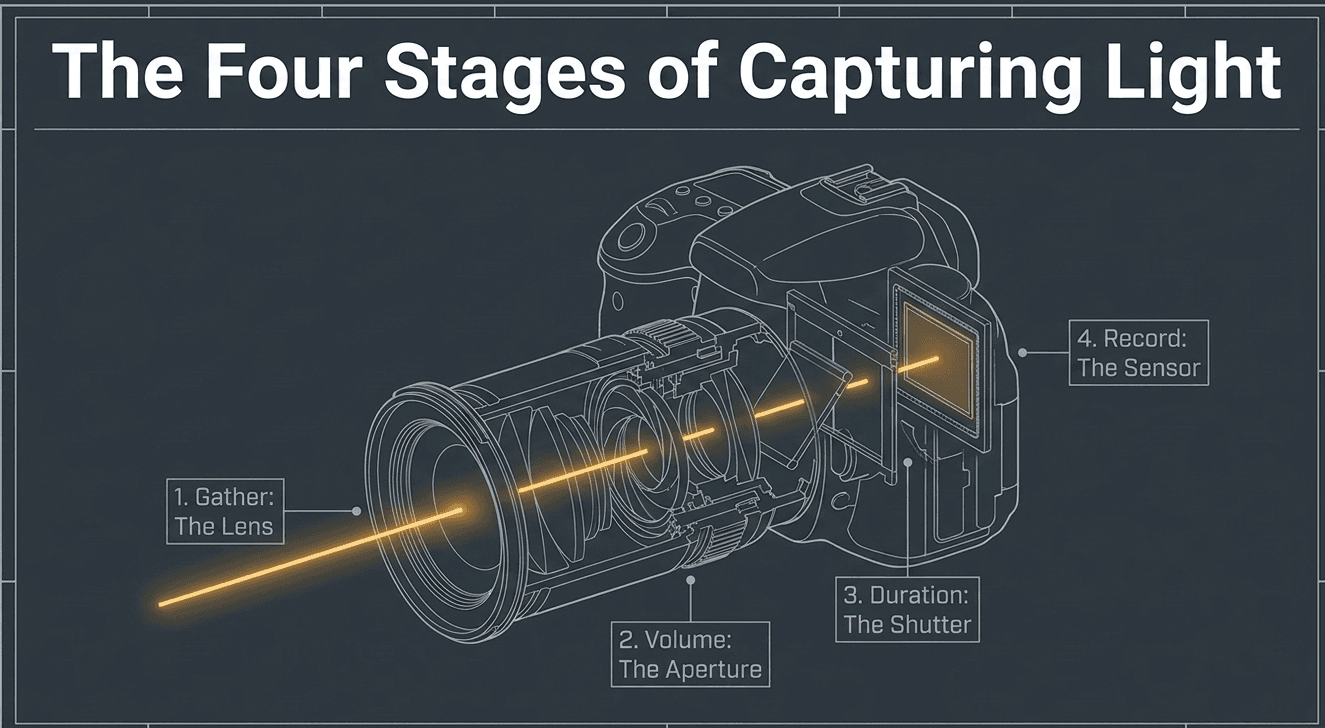
Strip away all the jargon, and every single photograph — from a phone snapshot to a Sony FX5 cinema frame — happens in three stages.
1. Light enters through the lens
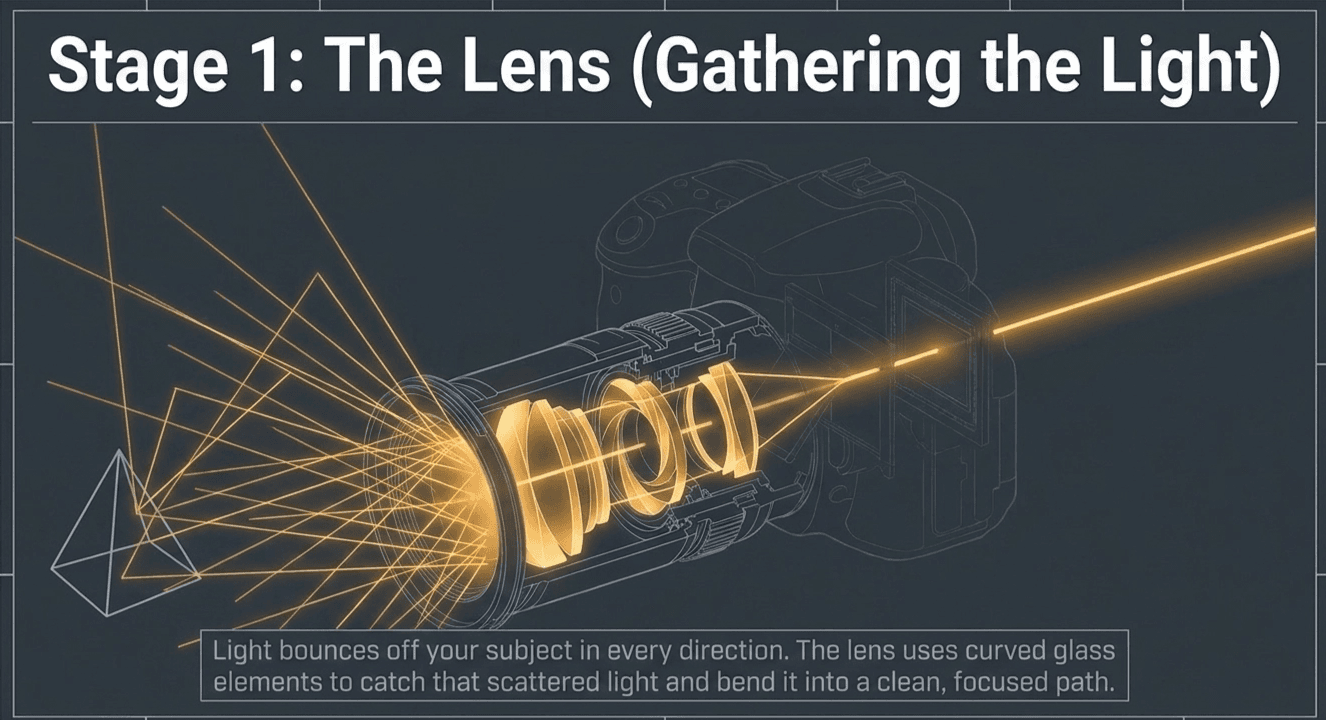
Light bounces off your subject in every direction. Your lens's job is to take that scattered light and bend it — through curved glass elements — so it converges into a clean, focused point of light for every point in the scene.
2. The aperture controls how much light gets in
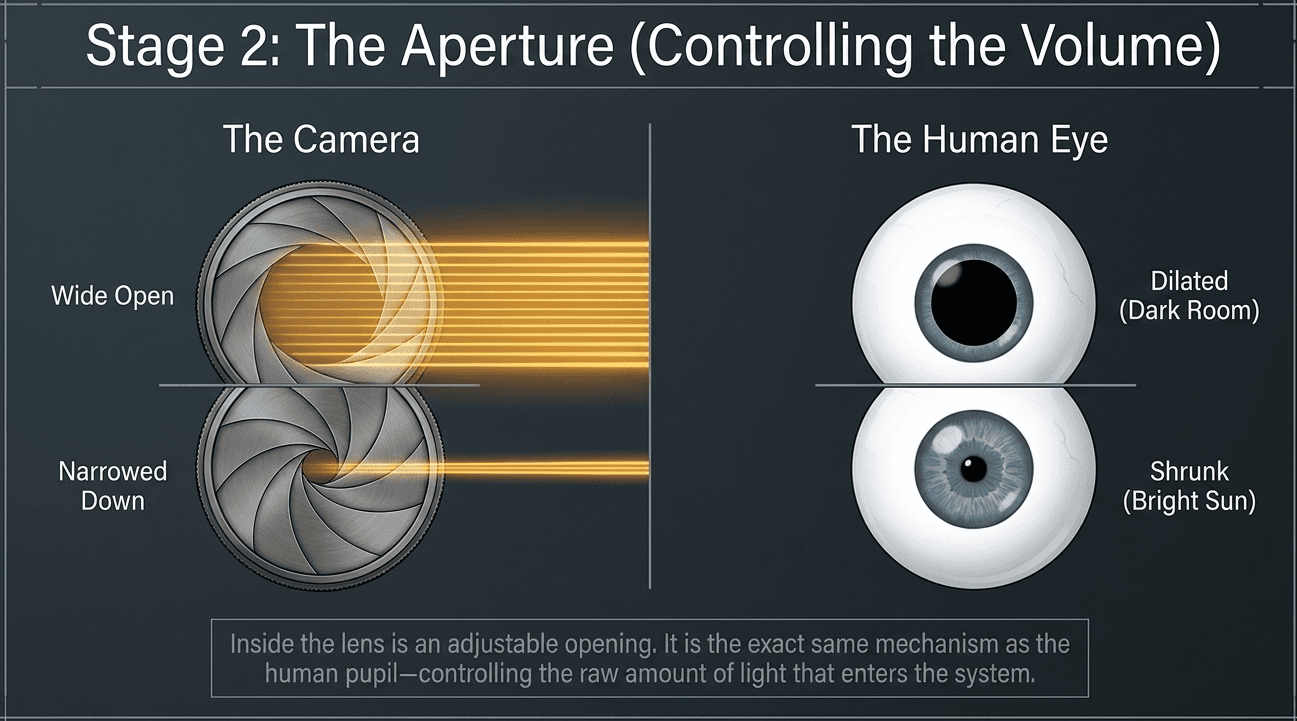
Inside the lens is an adjustable opening called the aperture (also called the diaphragm). Open it wide, and a flood of light rushes through. Narrow it down, and only a thin beam gets in. This is the same mechanism as your eye's pupil — it dilates in a dark room and shrinks in bright sun.
3. The shutter speed how much Time does the gate open
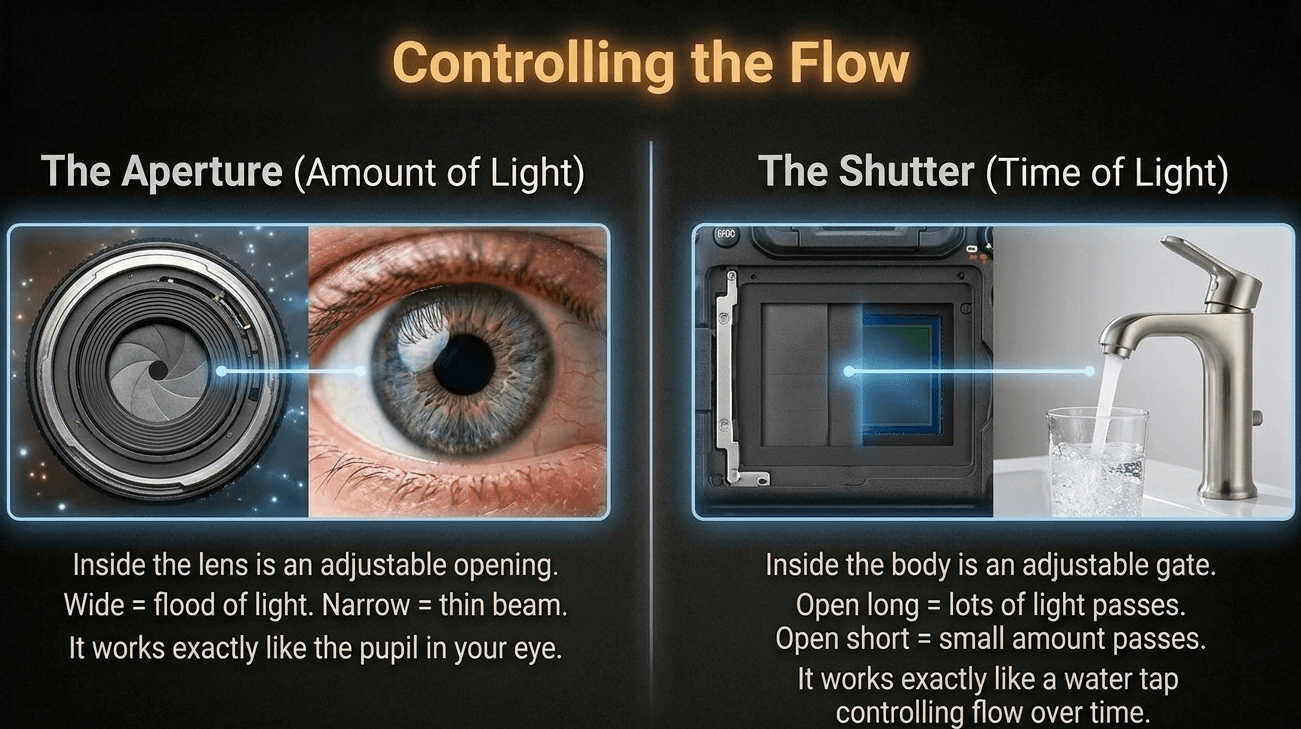
Inside the body there is adjustable gate called the shutter. Open it for long, and lot of light passes through. Open for less time, and only a small amount gets in. This is the same mechanism as your tap in your bathroom — If you need more water you open for long and if you want it less then you open short.
4. The sensor captures and records it
Behind the aperture, the focused light finally lands on the camera's sensor (a grid of millions of light-sensitive photosites). The sensor measures the intensity and color of light at every point and converts it into digital data — your image file.
The illustration below shows this exact path, from a mountain scene outside the camera to the moment the image lands, upside-down, on the sensor.
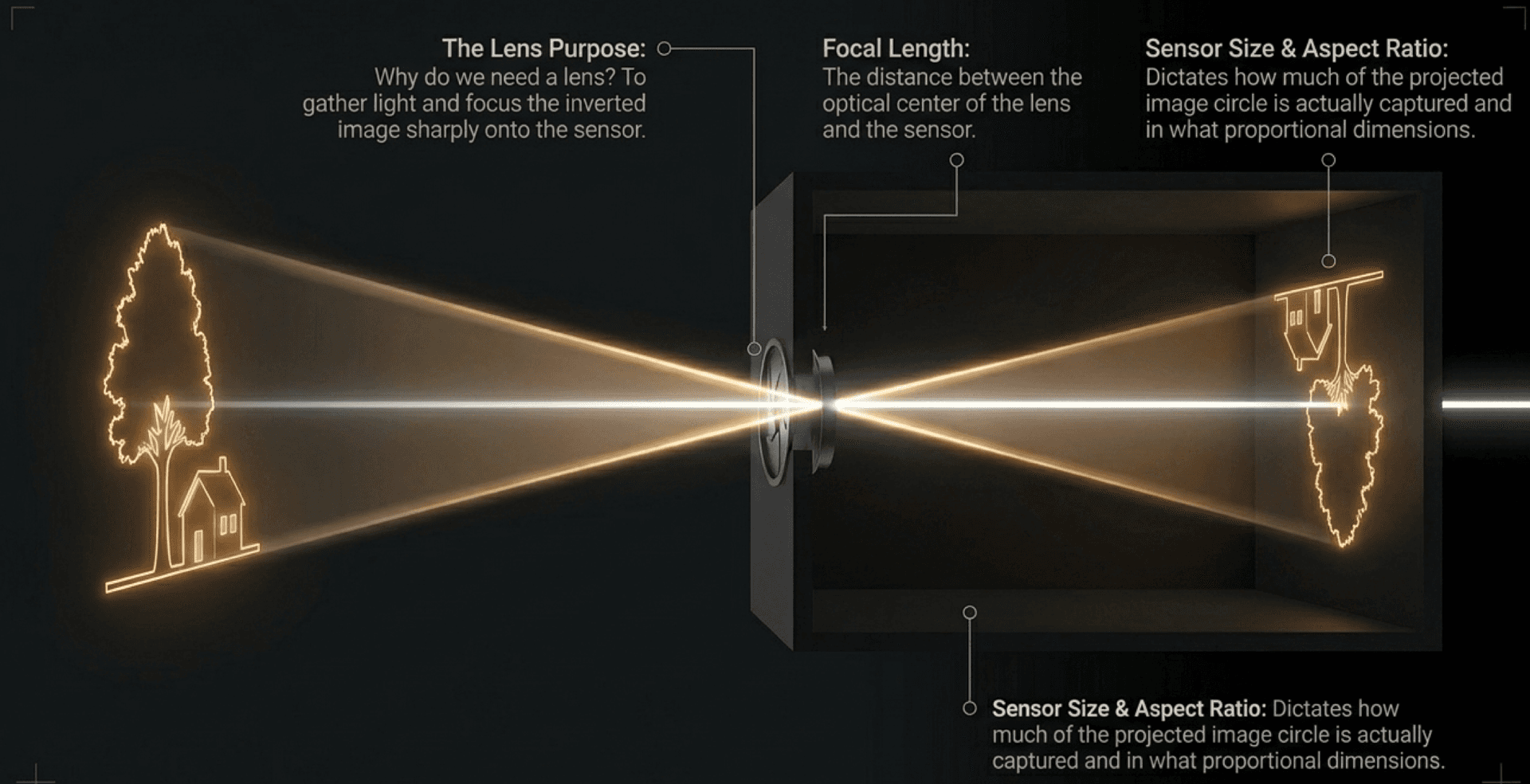
Fun fact: the image that actually lands on your sensor is upside down and reversed. Your camera's software (or, historically, a mirror and prism system) flips it right-side up before you see it on the screen. This is also why old view cameras and even the human eye form inverted images on the retina — your brain does the flipping there too.
Why a "camera" is really just a light-proof box
Strip away the modern electronics and a camera is one of the oldest, simplest inventions in visual history: a sealed box with a small hole that lets in a controlled amount of light, and something inside to catch it.
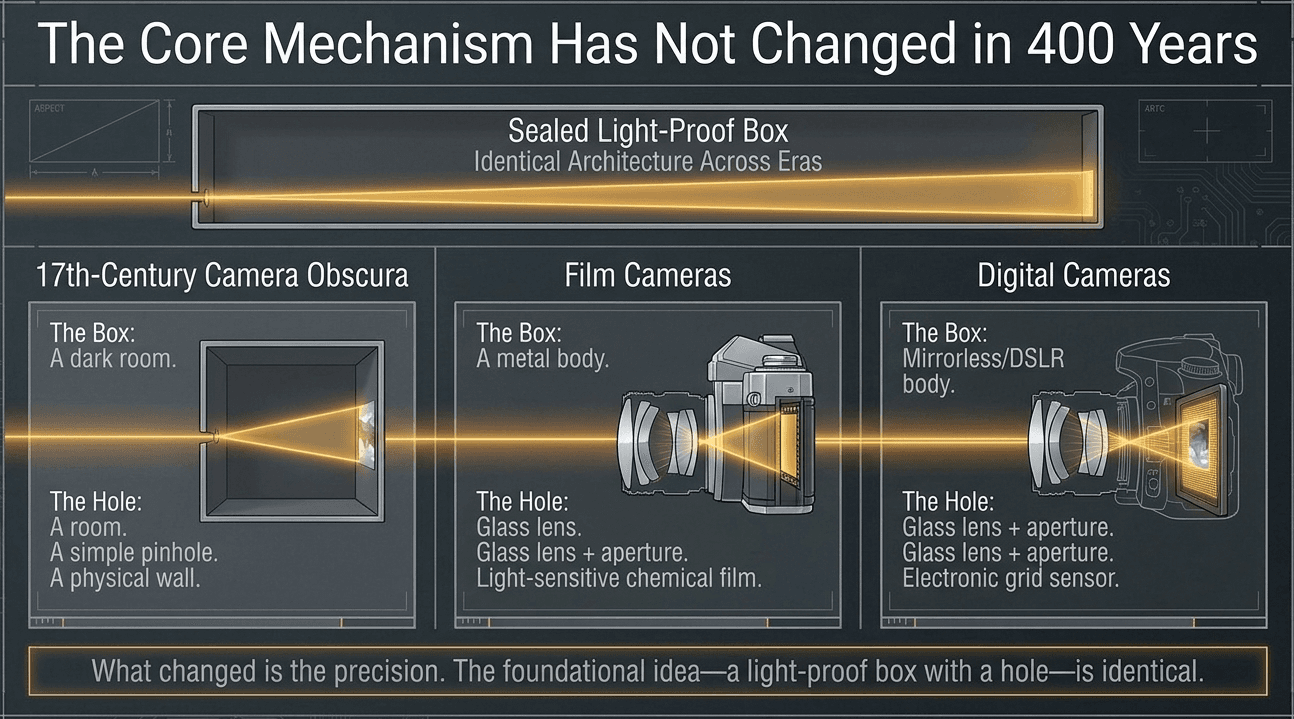
- 17th-century camera obscura used a pinhole and a wall.
- Film cameras used a lens and a strip of light-sensitive chemical film.
- Digital cameras — mirrorless or DSLR — use a lens and an electronic sensor.
The core idea has never changed in over 400 years. What's changed is precision: how accurately we can control the light, focus it, and record it. That's genuinely the entire story of camera technology.
Understanding "the image" — it's data, not a picture, at first
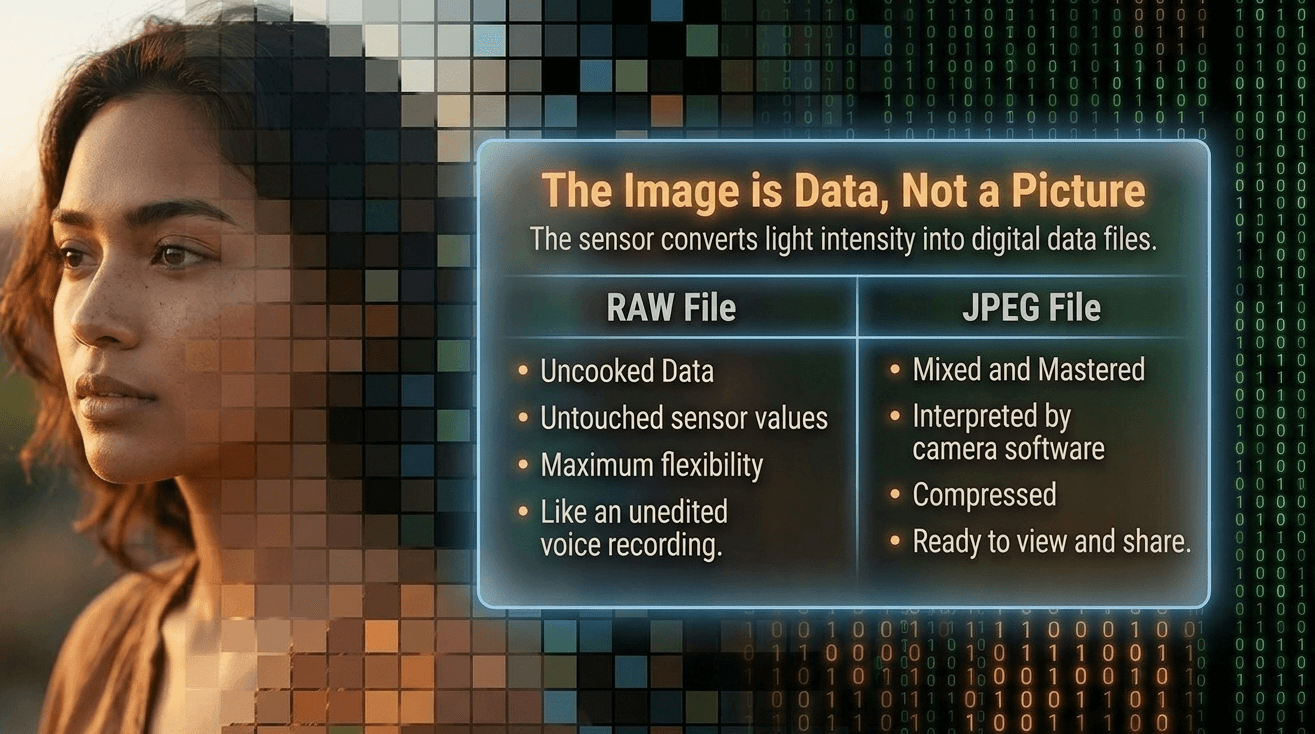
When your sensor captures light, it doesn't create a picture. It creates raw numerical data — the exact brightness and color value recorded at every single photosite. Your camera (or editing software like Lightroom) then interprets that data and renders it as the image you see.
This is exactly why RAW files exist, and why we spend an entire later module on RAW vs JPEG. A RAW file is the sensor's untouched data — like an unedited voice recording. A JPEG is already "mixed and mastered" by the camera. For a beginner, understanding this now — before you've even picked a camera — saves you months of confusion later.
A simple beginner exercise: see light like a photographer
Before your next class, or before you even buy a camera, try this for one full day, wherever you are — Basantapur Durbar Square, your rooftop in Tahachal, or a Thamel café window seat:
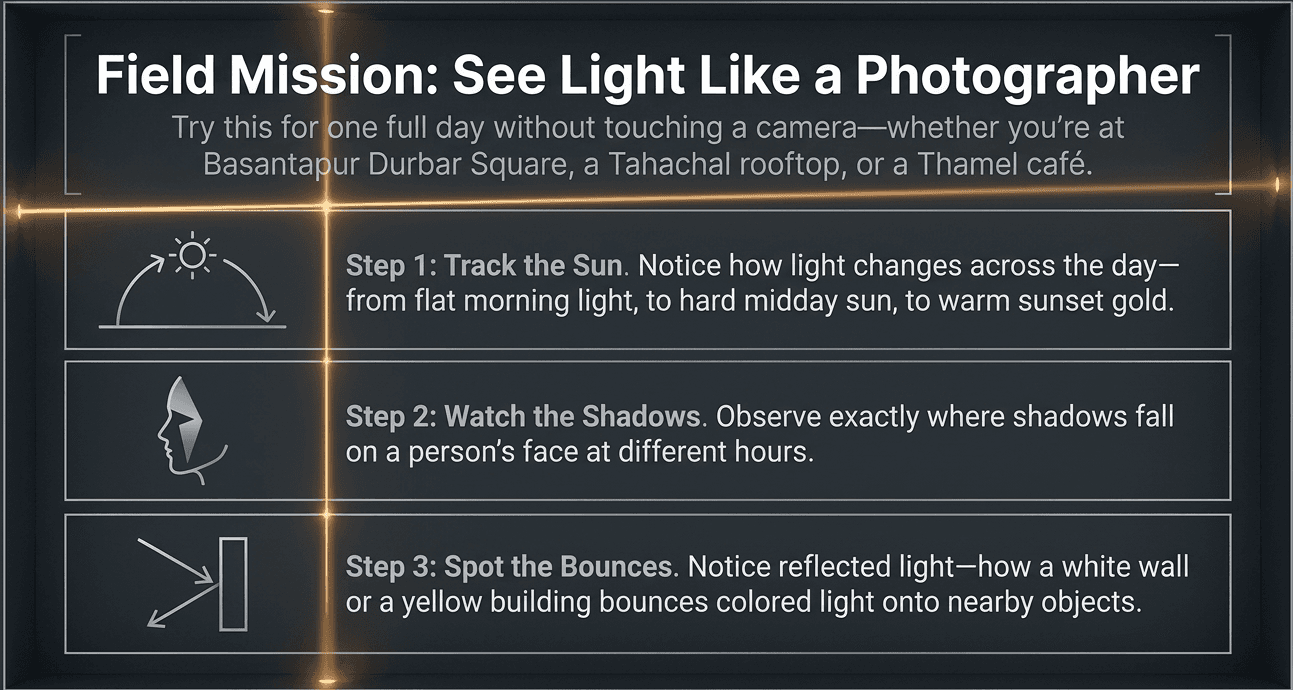
- Notice how the light changes color and softness across the day — from cool, flat morning light, to hard directional midday sun, to warm golden light near sunset.
- Look at where shadows fall on a person's face at different hours.
- Notice reflected light — how a white wall or a yellow building can bounce colored light onto whatever's near it.
This single habit — watching light instead of watching subjects — is the single biggest shift between someone who takes snapshots and someone who's beginning to think like a photographer.
What comes next in this series
Module 1 is the "why" behind everything you'll do with a camera. From here, the roadmap moves into hands-on decisions and controls:
- DSLR vs Mirrorless vs Smartphone — choosing your first camera
- Camera Anatomy 101 — every button and dial explained
- Manual vs Auto Modes — which one you should actually shoot in
- RAW vs JPEG — why professionals never shoot JPEG-only
- How to Hold a Camera Properly — fixing blurry photos at the source
Learn this hands-on at Zyamaru Films Academy, Kathmandu
Reading about light and cameras is a good start — but photography is a physical, visual skill, and it's genuinely learned faster with a camera in your hands and someone correcting your grip, your framing, and your exposure in real time.
At Zyamaru Films Academy in Tahachal, Kathmandu, our Basic Photography to Cinematography course walks beginners through exactly this roadmap — starting from these fundamentals and building up to full cinematography — over one month, six days a week, taught by an industry-active cinematographer with hands-on access to professional gear.
Turn Passion Into Profession.
Frequently asked questions
Do I need an expensive camera to start learning photography?
No. Understanding light, exposure, and composition matters far more than gear at the beginner stage. Many students start with an entry-level DSLR, a mirrorless body, or even a smartphone with manual controls.
What's the very first thing I should learn in photography?
How light behaves — its direction, softness, and color — and how the three stages of a photograph (lens, aperture, sensor) work together. Camera settings only make sense once this foundation is in place.
How long does it take to learn photography basics?
With consistent, guided practice — like Zyamaru's 10 days, 2hrs a day format — most beginners can confidently understand and control exposure, composition, and basic lighting within a a weeks.
How long does it take to learn photography to cinematography?
With consistent, guided practice — like Zyamaru's one-month, six-day-a-week format — most beginners can confidently understand and control exposure, composition, and basic lighting within a few weeks.