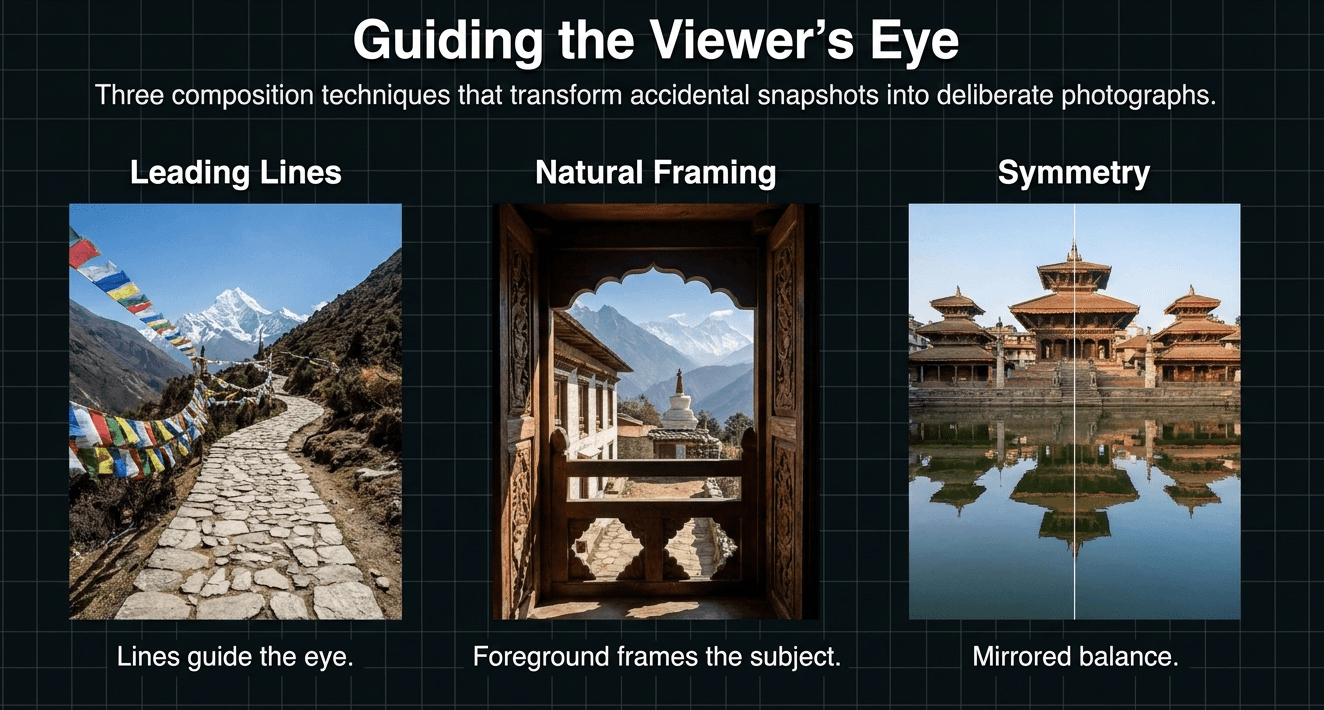
Leading Lines, Framing & Symmetry: Composition Techniques That Instantly Improve Your Photos
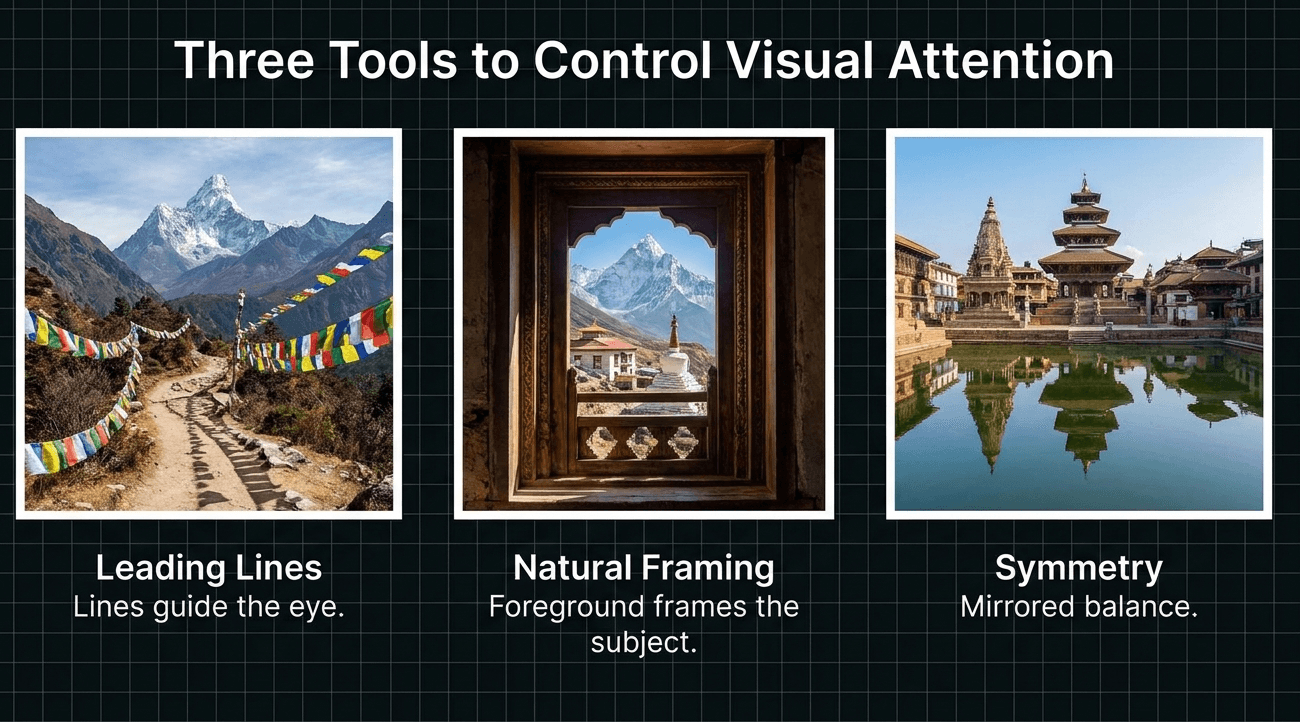
The rule of thirds, covered in the last post, is about where to place your subject. This post covers three techniques about something different: how to guide the viewer's eye toward that subject, and how to use the rest of the frame to support it rather than compete with it.
These three techniques — leading lines, natural framing, and symmetry — are some of the fastest, most reliable ways to make an ordinary scene feel deliberately composed rather than accidentally photographed.
Leading lines: using the scene itself to point at your subject
Leading lines are any lines within your frame — roads, fences, staircases, rivers, rows of pillars, even a glance or gesture — that draw the viewer's eye toward your main subject. The eye naturally follows a line once it spots one, which makes leading lines one of the most reliable ways to control exactly where attention goes in a photo.
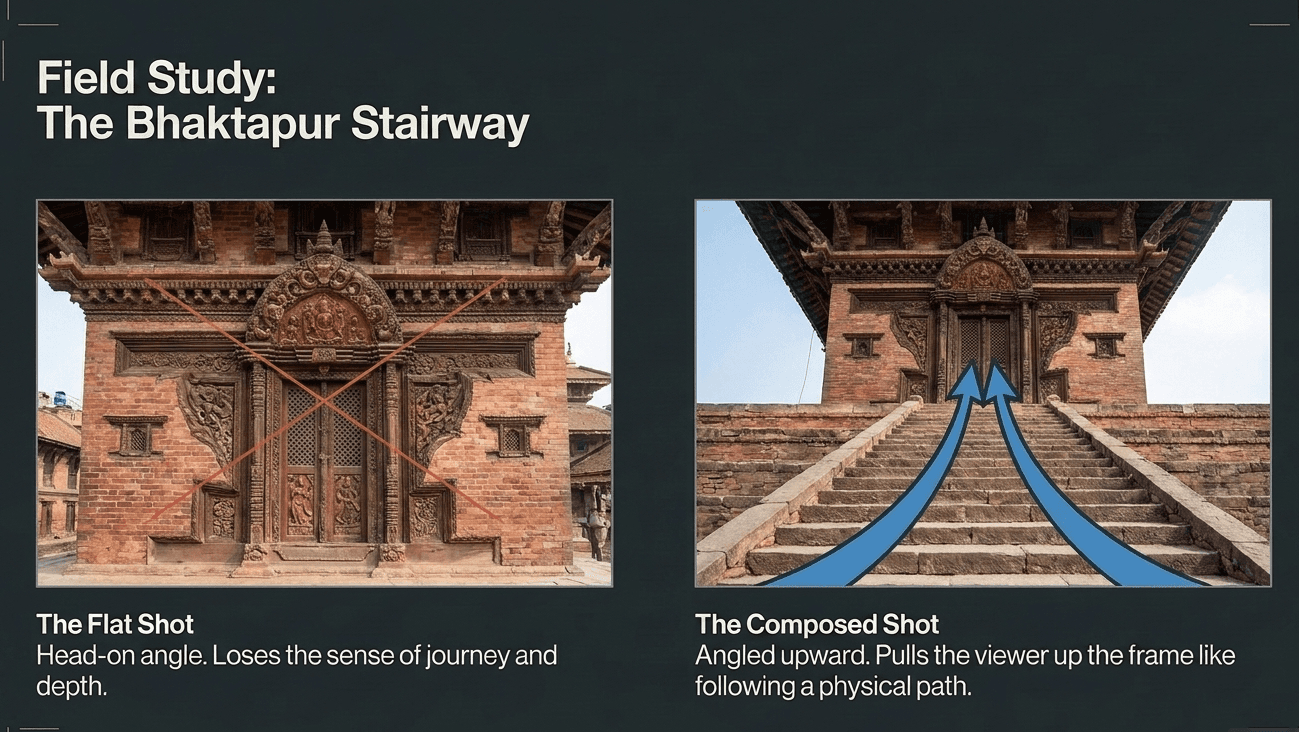
Example — a stone stairway in Bhaktapur Durbar Square: Photographing a temple stairway from the base, with the steps converging upward toward a carved doorway at the top, pulls the viewer's eye directly up the frame toward that doorway, almost like following a path with your eyes before your feet ever move. Shoot the same doorway from a flat, head-on angle with no visible stairway leading into it, and the photo loses that sense of journey and depth entirely.
Where to find leading lines in everyday scenes:
- Roads, paths, and staircases
- Rivers, fences, and rows of buildings
- Architectural elements — pillars, railings, rooflines
- Even implied lines, like a row of people's gazes all looking toward one point
Leading lines work especially well combined with the rule of thirds from the last post — a line leading toward a power point creates one of the strongest, most classically pleasing compositions in photography.
Natural framing: using foreground elements to frame your subject
Framing means deliberately using something in the foreground — a doorway, an archway, overhanging branches, a window — to surround or partially enclose your main subject, the way a physical picture frame surrounds a painting. It draws the eye inward toward the subject and adds a sense of depth and context that a flat, frameless shot doesn't have.
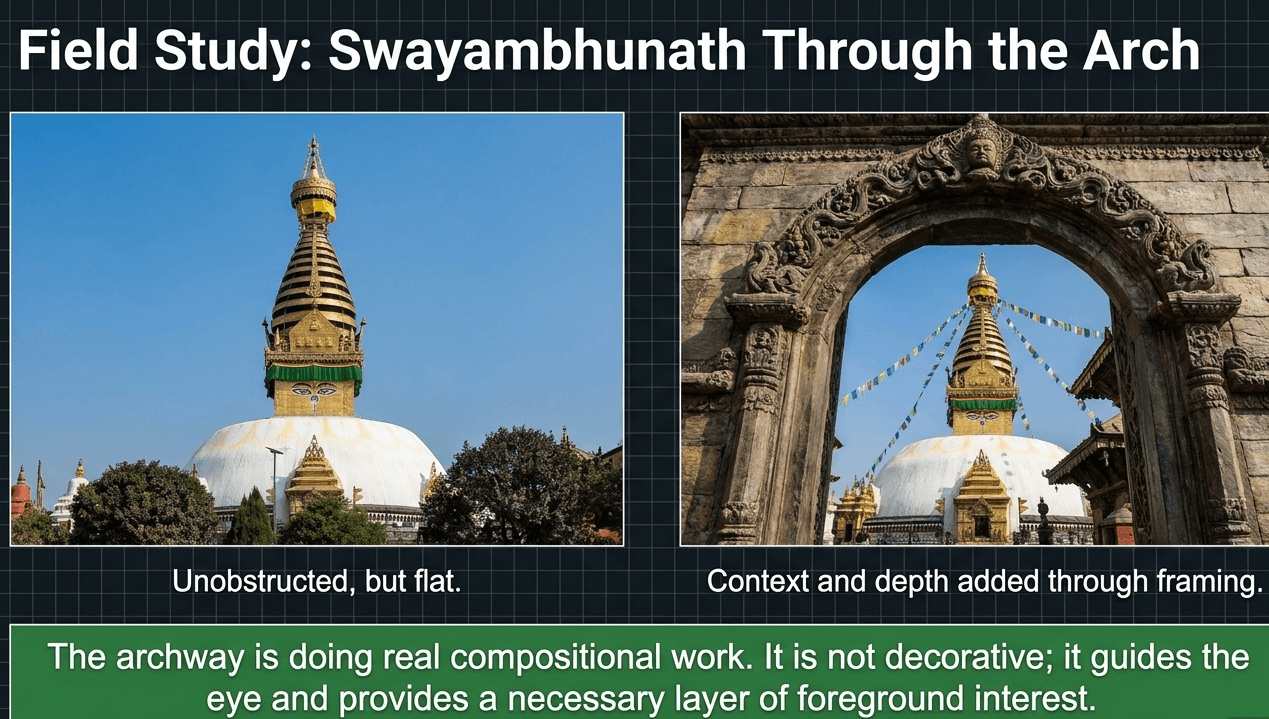
Example — Swayambhunath Stupa through a temple archway: Positioning yourself so a stone archway or a hanging string of prayer flags occupies the edges of the frame, with the stupa visible through the gap in the center, immediately gives the photo a sense of place and depth that a straight, unobstructed shot of the stupa alone wouldn't have. The archway isn't just decoration — it's doing real compositional work, guiding the eye and adding a layer of foreground interest.
Common natural frames to look for:
- Doorways, archways, and windows
- Overhanging tree branches or foliage
- Gaps between buildings or crowds of people
- Shadows or silhouetted foreground objects at the edges of the frame
Symmetry: when centering the subject is actually the right call
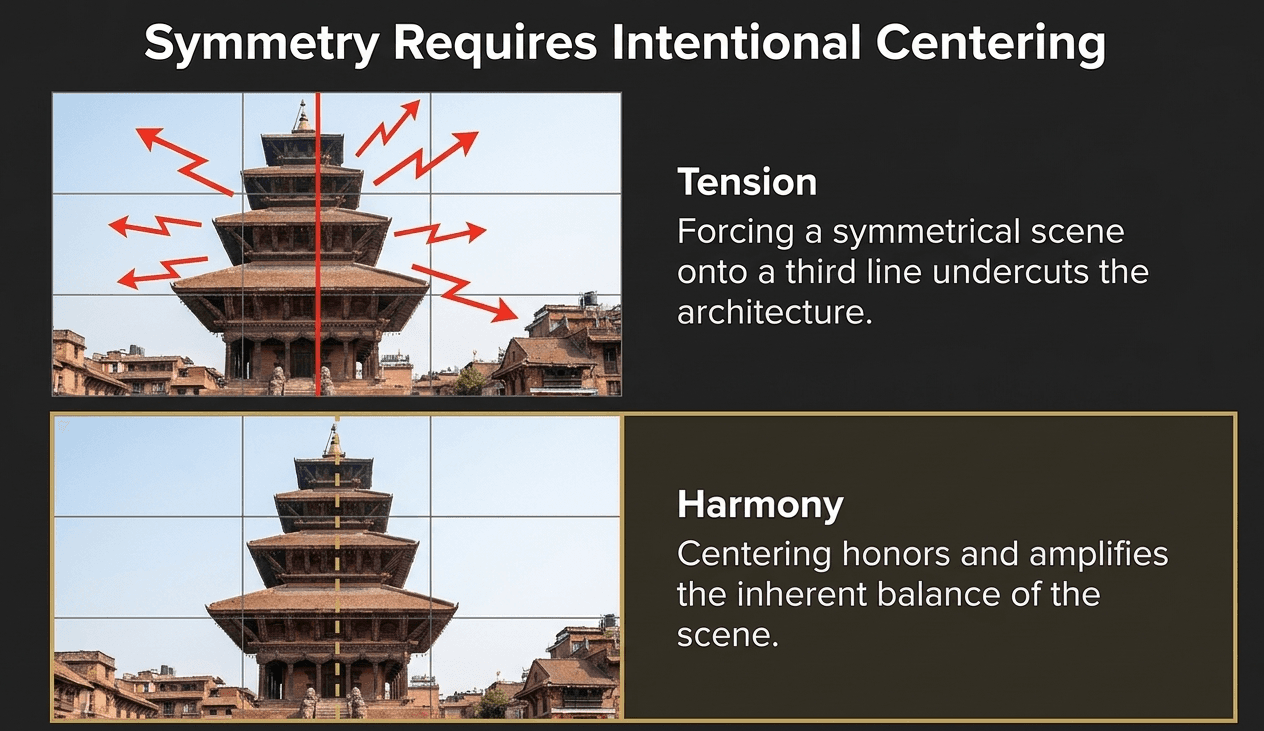
We flagged this at the end of the rule of thirds post: symmetrical scenes are the clearest exception to off-center composition. When a scene is naturally symmetrical — mirrored, balanced, architecturally aligned — centering your subject often produces a far stronger photo than forcing it onto a third line would.
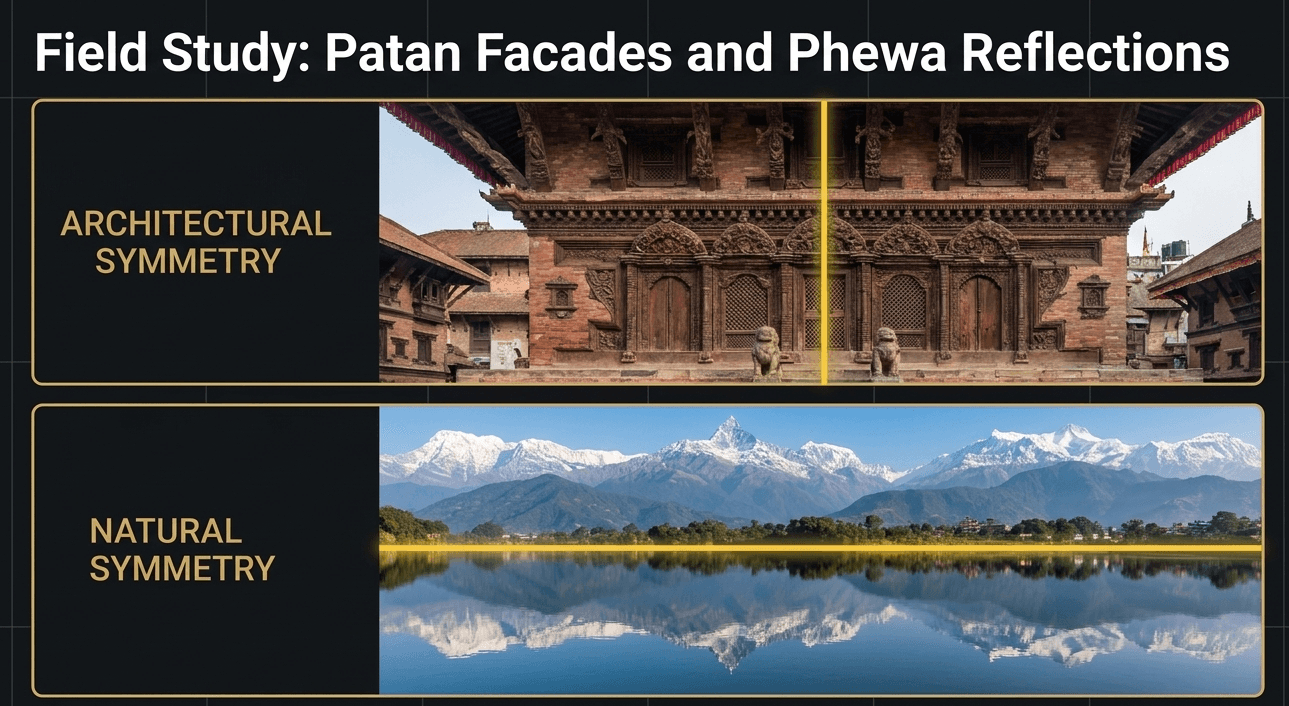
Example — Phewa Lake reflection in Pokhara: On a still morning, the surrounding hills reflect almost perfectly in the lake's calm surface. Centering the horizon line exactly in the middle of the frame, rather than placing it on an upper or lower third, lets the reflection create a genuinely symmetrical, mirror-like composition — breaking the usual rule of thirds guidance is exactly what makes this particular photo work.
Example — a temple facade in Patan Durbar Square: Many Newari temple facades are built with deliberate architectural symmetry — matching carved windows, aligned pillars, a centered doorway. Photographing the facade dead-on, with the doorway centered in the frame, honors and amplifies that symmetry. Shifting the same shot off-center onto a third line would actually undercut the very thing that makes the architecture visually striking.
How these three techniques work together
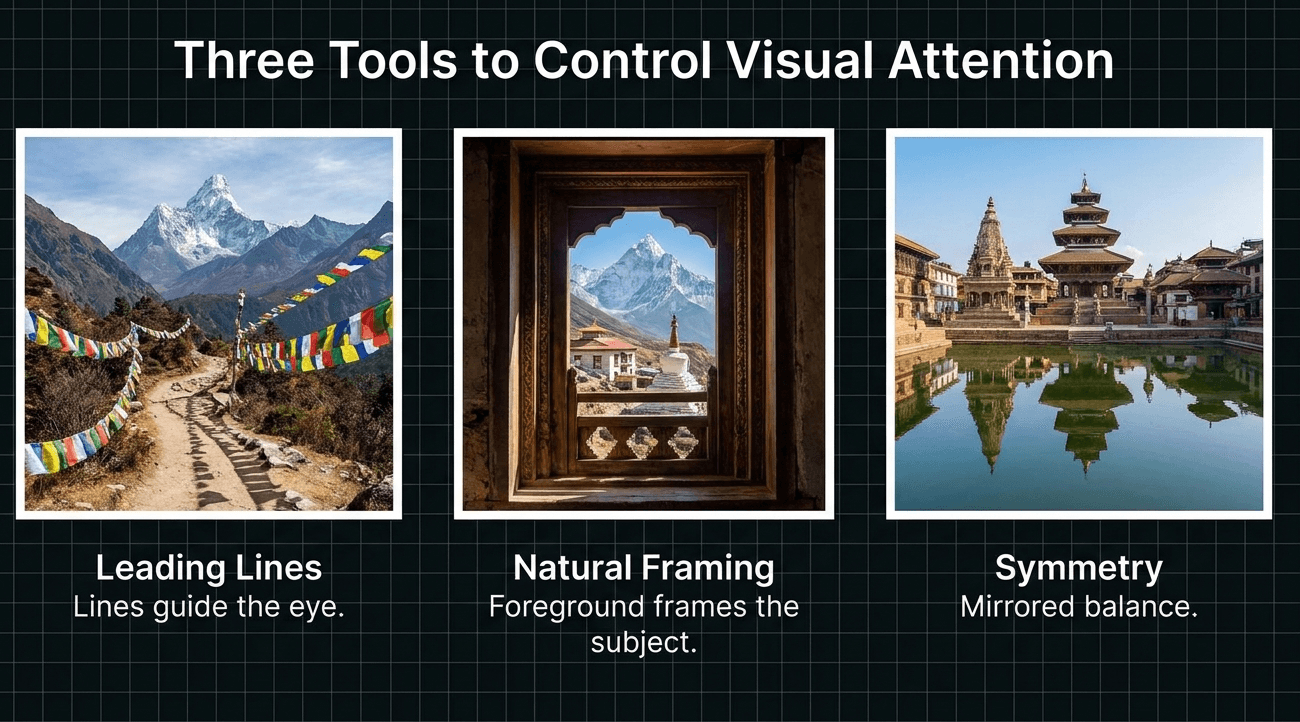
These aren't three separate tools you pick one from — strong photographers often combine them in a single frame. A stairway leading line (technique one) might pass through an archway that frames the shot (technique two), leading toward a symmetrical building facade at the far end (technique three). Kathmandu's temple architecture, in particular, offers this kind of layered composition constantly, if you're looking for it.
A common beginner mistake: forcing lines or frames that don't actually exist
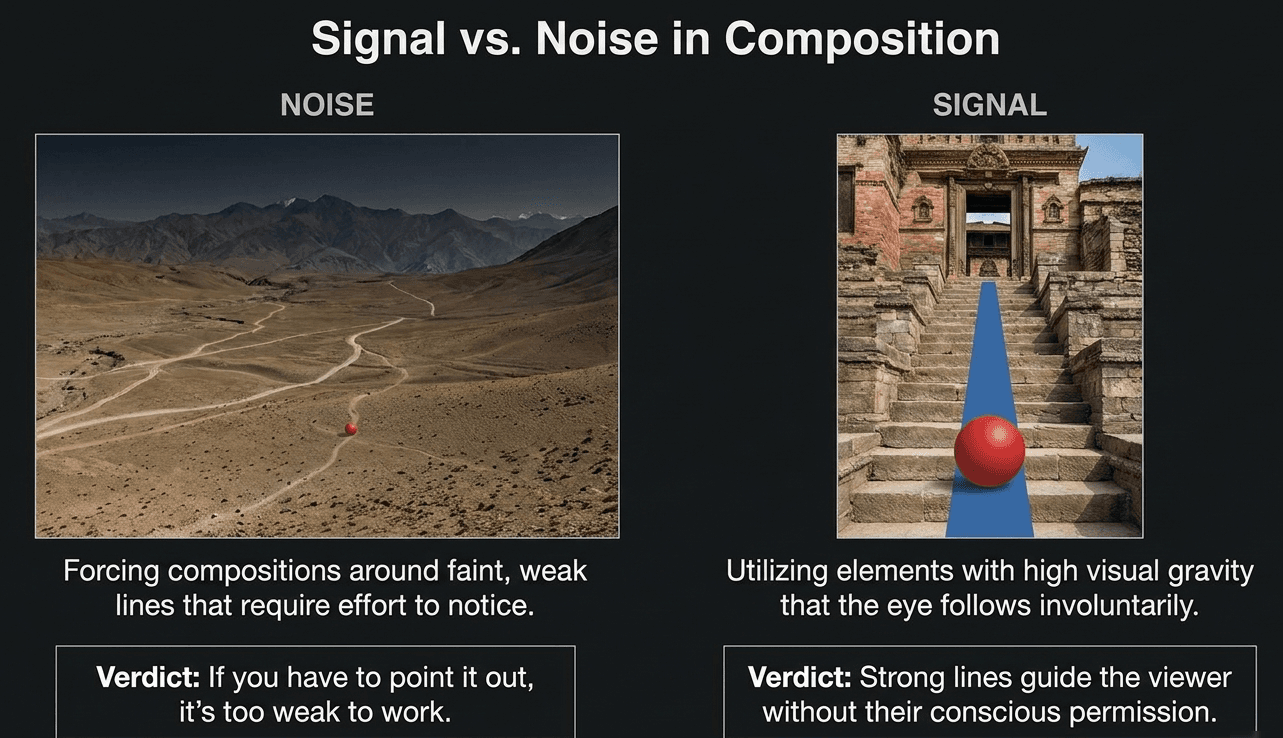
Some new students start seeing "leading lines" everywhere and force compositions around faint, weak lines that don't genuinely draw the eye — a slightly uneven pavement crack, for instance, rather than a clear, strong line like a staircase or road. The technique only works when the line is visually strong enough for a viewer's eye to actually notice and follow it without effort. If you have to point it out for someone to see it, it's probably too weak to be doing real compositional work.
A practice drill: one location, three techniques
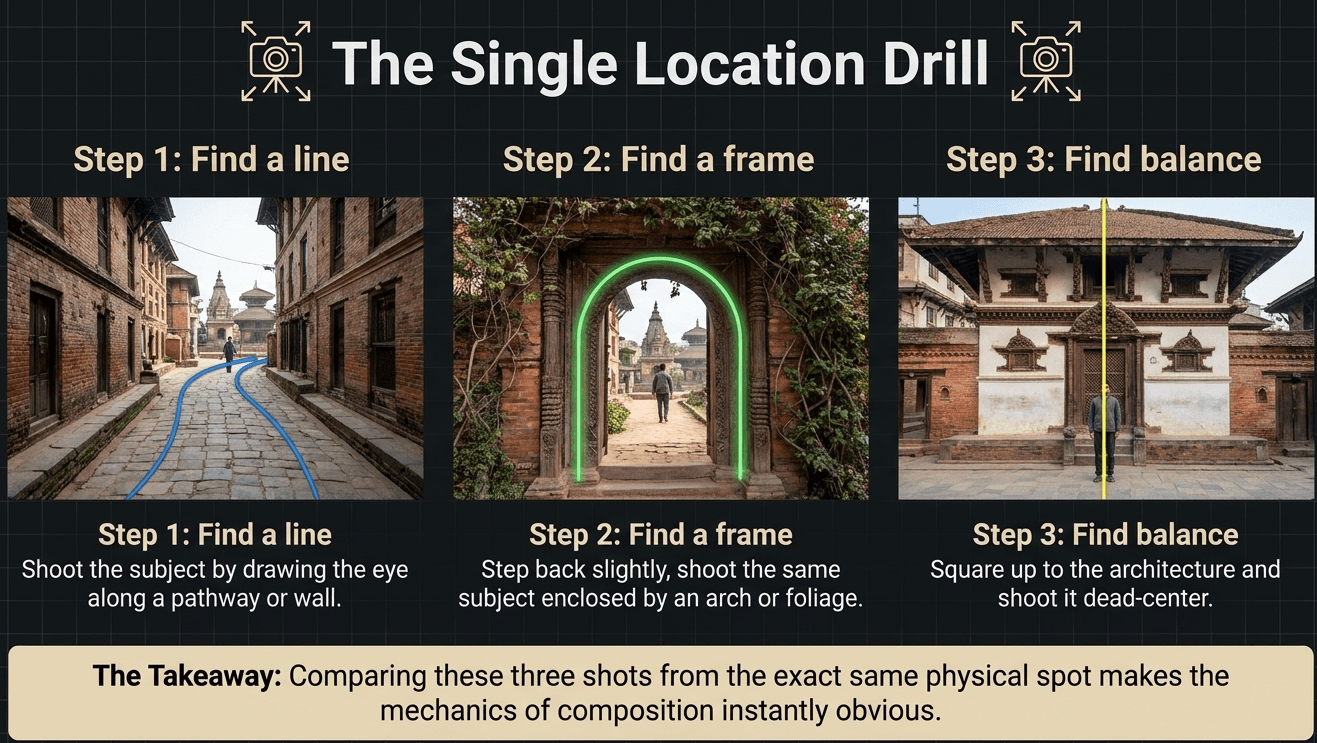
Pick a single spot — a street corner, a temple courtyard, a doorway — and deliberately shoot it three different ways: once using a leading line to draw the eye toward a subject, once using a natural frame around a subject, and once (if the location allows) as a centered, symmetrical composition. Comparing all three from the same physical spot makes the differences between these techniques far more obvious than reading about them separately.
What comes next in this module
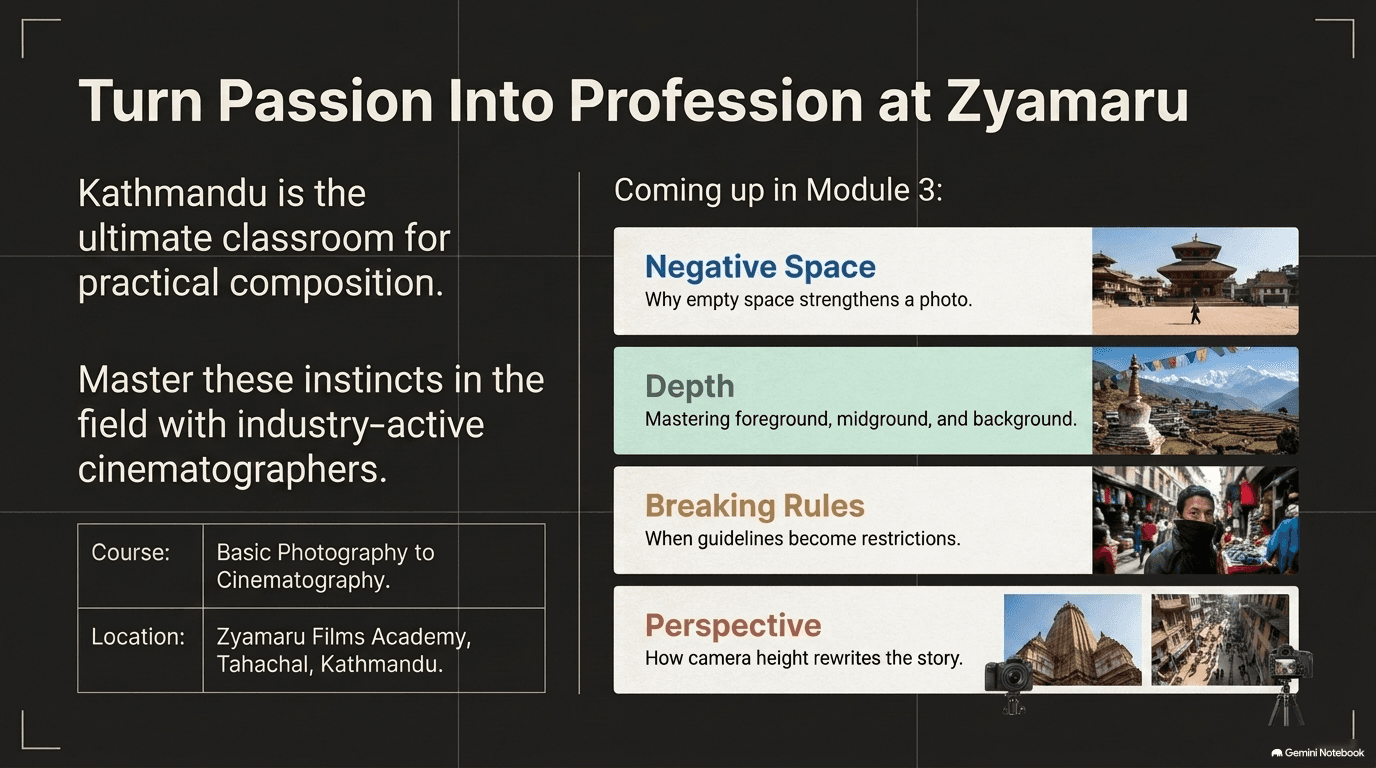
- Negative Space — why empty space can make a photo stronger, not weaker
- Foreground, Midground, Background — creating a sense of depth in a flat, two-dimensional image
- When to Break Composition Rules — and why rules are guidelines, not laws
- Perspective & Angles — how camera height changes the entire story of a photo
Practice these techniques hands-on at Zyamaru Films Academy
Kathmandu's temples, courtyards, and streets are genuinely one of the best classrooms in the world for practicing leading lines, framing, and symmetry — and spotting them quickly, in the moment, is exactly the kind of instinct our instructors build with students in the field. Our Basic Photography to Cinematography course at Zyamaru Films Academy in Tahachal, Kathmandu includes location-based composition sessions guided by an industry-active cinematographer.
Turn Passion Into Profession.
Frequently asked questions
What are leading lines in photography?
Leading lines are visual lines within a photo — roads, staircases, fences, rivers, and similar elements — that guide the viewer's eye toward the main subject, adding a sense of direction and depth to the composition.
When should I use symmetry instead of the rule of thirds?
Symmetry works best with naturally balanced or mirrored scenes, like reflections, architecturally aligned buildings, or centered doorways, where centering the subject amplifies the scene's inherent balance rather than working against it.
Can I combine leading lines, framing, and symmetry in one photo?
Yes, and strong photographers often do exactly this — a leading line might guide the eye through a natural frame toward a symmetrical subject, layering multiple composition techniques within a single, well-considered shot.