Perspective & Angles: How Camera Height Changes the Story of a Photo
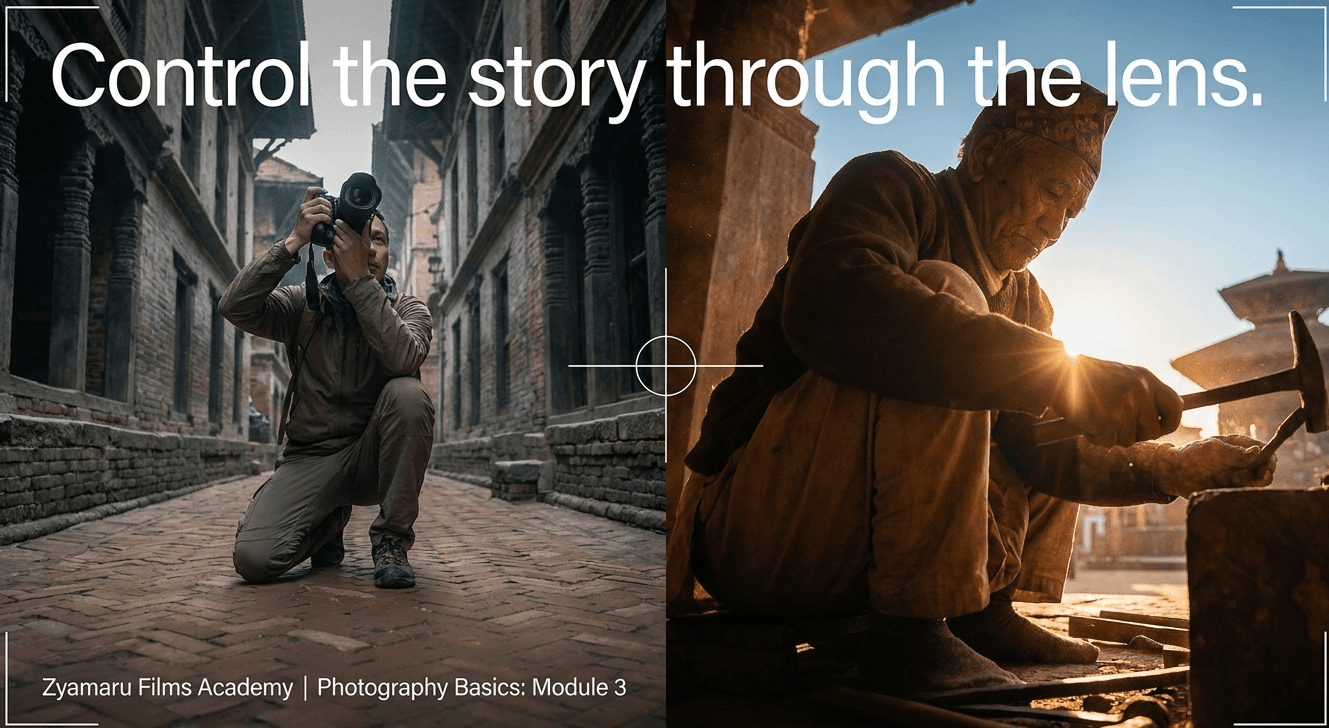
This is the final post in Module 3, and it covers a decision so simple it's easy to overlook entirely: where do you physically put the camera before you even think about aperture, composition, or light? Camera height and angle change the emotional meaning of a photo more dramatically than almost any other single choice — and most beginners never move the camera from chest height at all.
Why camera height isn't just a technical detail
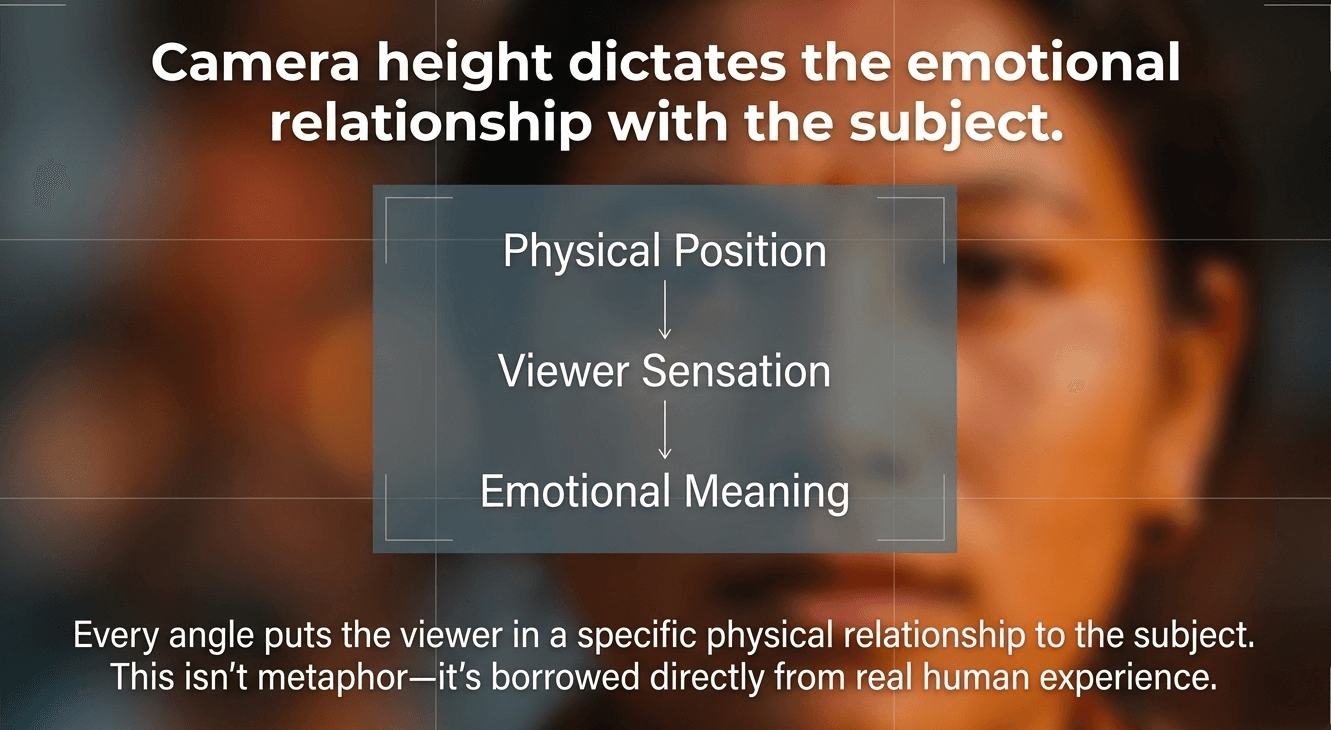
Every angle you choose puts the viewer in a specific physical relationship to the subject. Shoot from below, and the viewer looks up — the same physical sensation as standing in front of someone taller or more imposing. Shoot from above, and the viewer looks down — the same sensation as looking at something small, young, or vulnerable. This isn't metaphor; it's borrowed directly from real physical experience, which is exactly why it works so reliably on a viewer's emotions.
Low angle: looking up at the subject
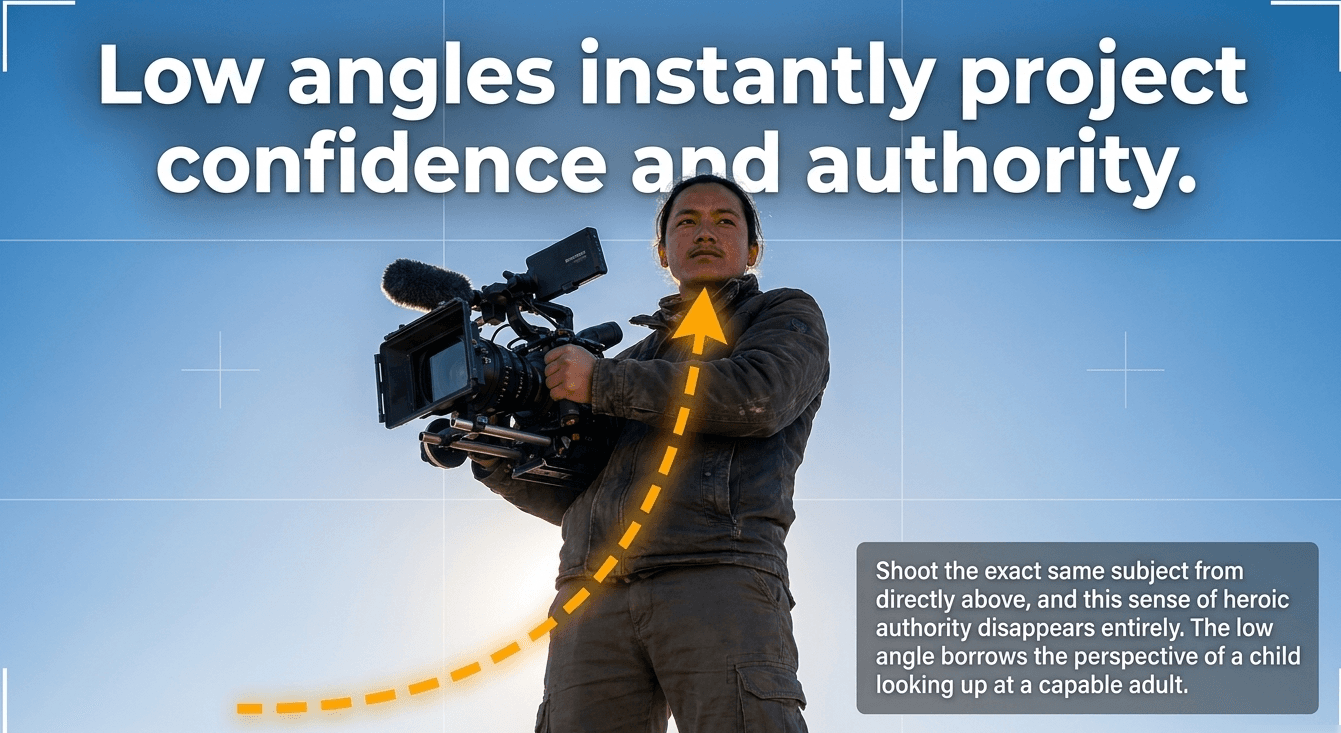
Positioning the camera below your subject's eye level, tilted upward, makes the subject appear larger, taller, and more dominant in the frame — the same visual sensation as a child looking up at an adult, or a viewer looking up at a towering statue.
Example — a student cinematographer photographed with their camera rig, shot from knee height looking up:
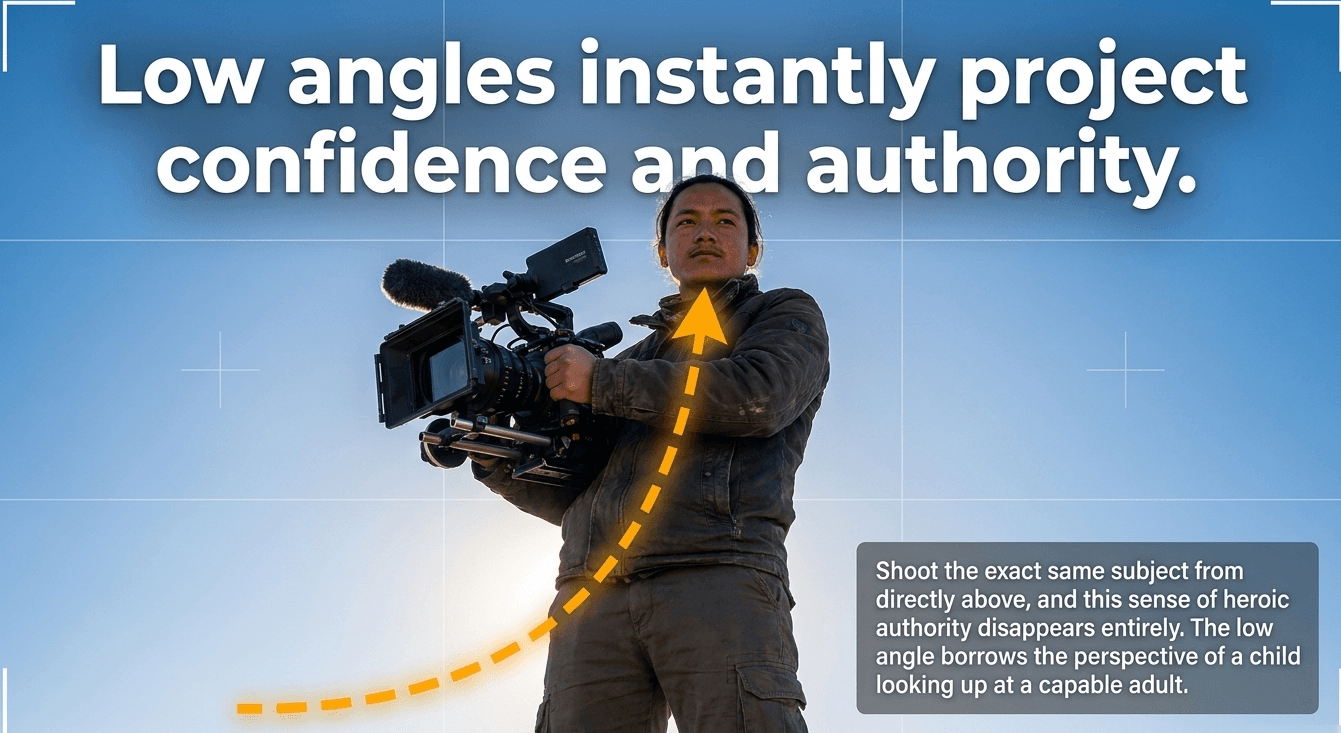
This angle instantly reads as confident, capable, even heroic, with the sky or ceiling providing a clean, uncluttered backdrop behind them — a common technique in documentary profiles of skilled professionals. Shoot the exact same subject from directly above instead, and that sense of authority disappears entirely.
Example — Dharahara or a temple spire, shot from directly beneath looking up:
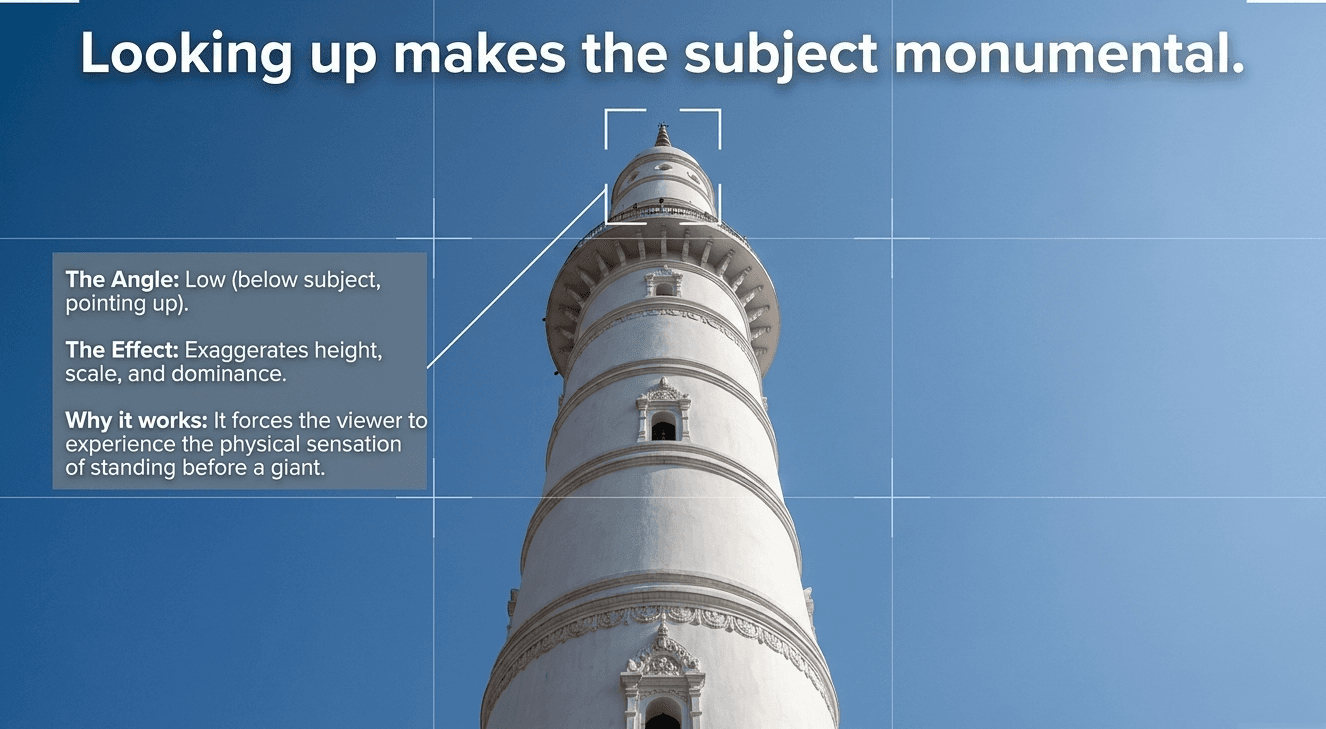
A low angle exaggerates the height and scale of tall architecture far more dramatically than a shot taken from across the street at eye level, making the structure feel genuinely monumental.
Eye level: the neutral, relatable default
Shooting from roughly the same height as your subject's eyes is the most neutral, natural-feeling perspective — it mirrors how we actually experience looking at another person face-to-face in real life. This is why eye level dominates portrait photography and most documentary interview setups: it invites the viewer to relate to the subject as an equal, rather than looking up at or down on them.
Example — a portrait of a Old lady at Zyamaru Films Academy:
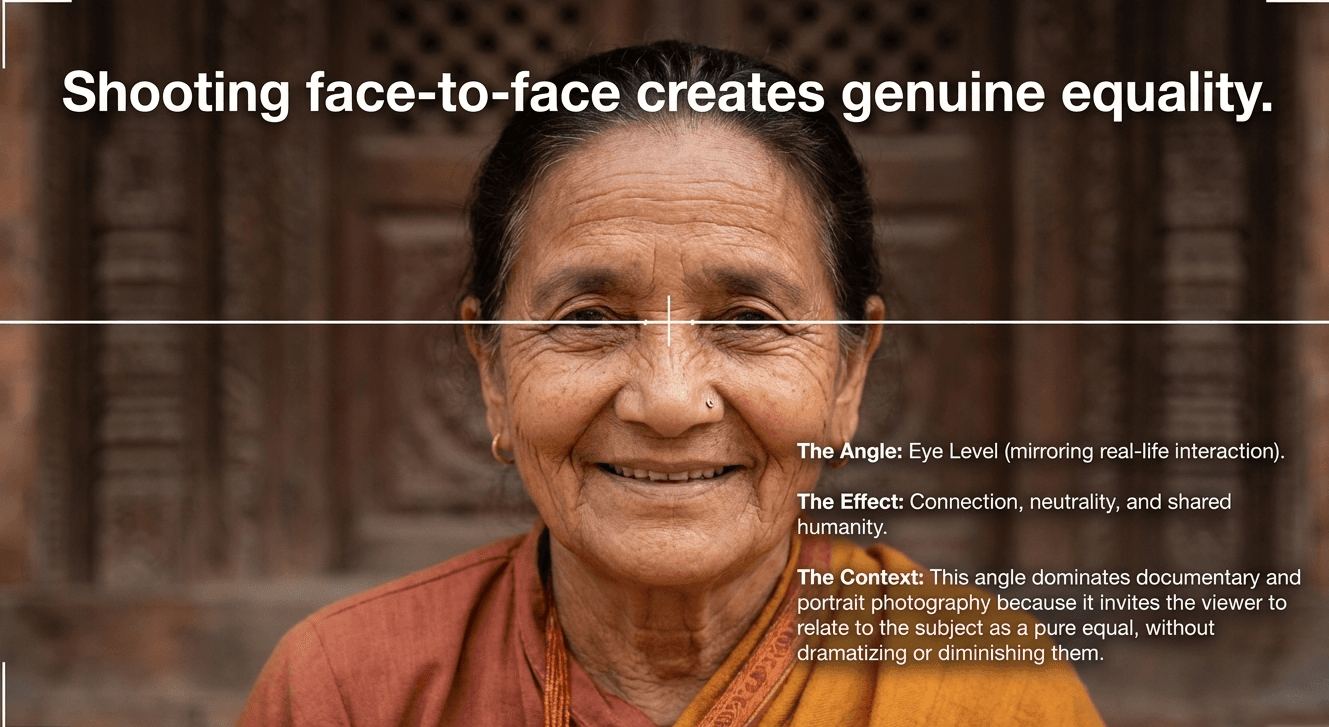
Shooting at the exact height of their eyes, rather than standing and shooting down at a seated subject, creates a genuine sense of connection and equality between subject and viewer — appropriate for a photo meant to celebrate the person, not dramatize or diminish them.
High angle: looking down at the subject
Positioning the camera above your subject, tilted downward, makes the subject appear smaller, more vulnerable, or more isolated within their surroundings — the same sensation as an adult looking down at a child, or looking down from a height at someone below.
Example — photographing a lone figure crossing a wide, empty street in old Kathmandu from a rooftop or balcony above:
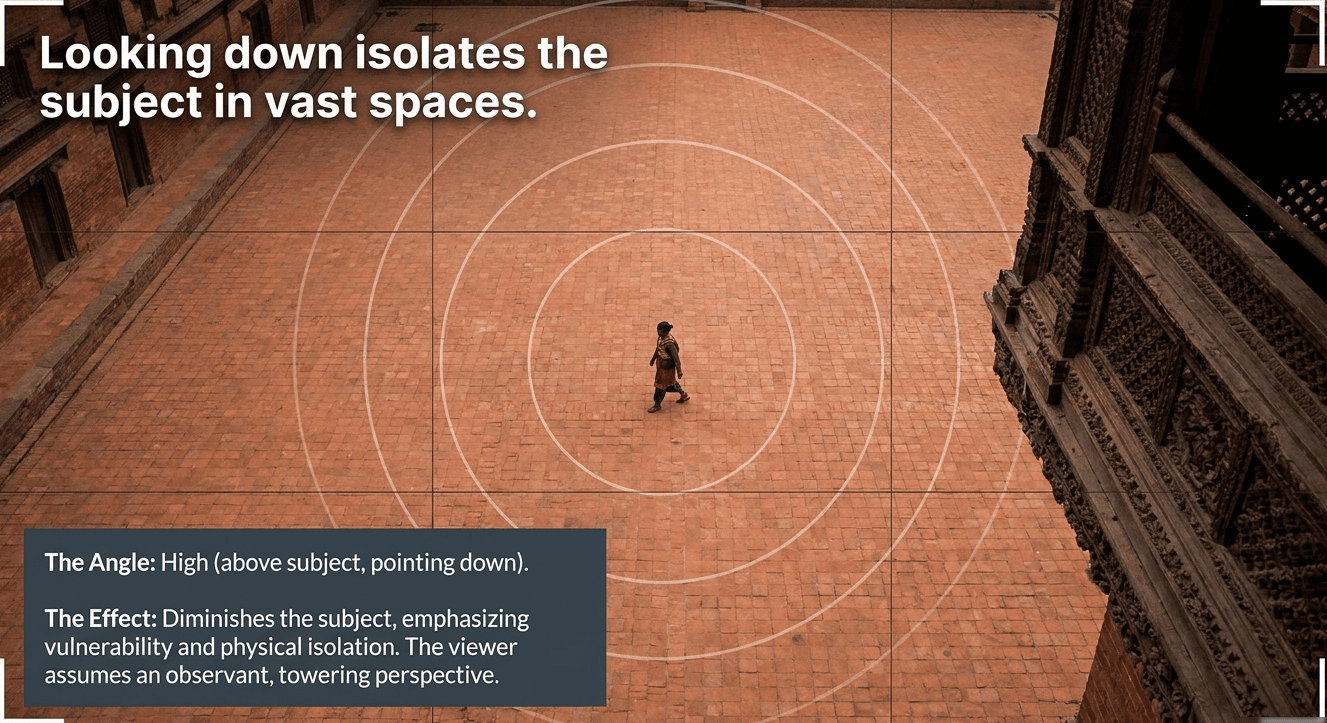
The high angle emphasizes how small and alone the figure appears against the vast surrounding space, creating a mood of isolation that a ground-level shot of the same person wouldn't capture nearly as effectively.
Example — a bird's-eye shot of a crowded festival gathering from an elevated vantage point:
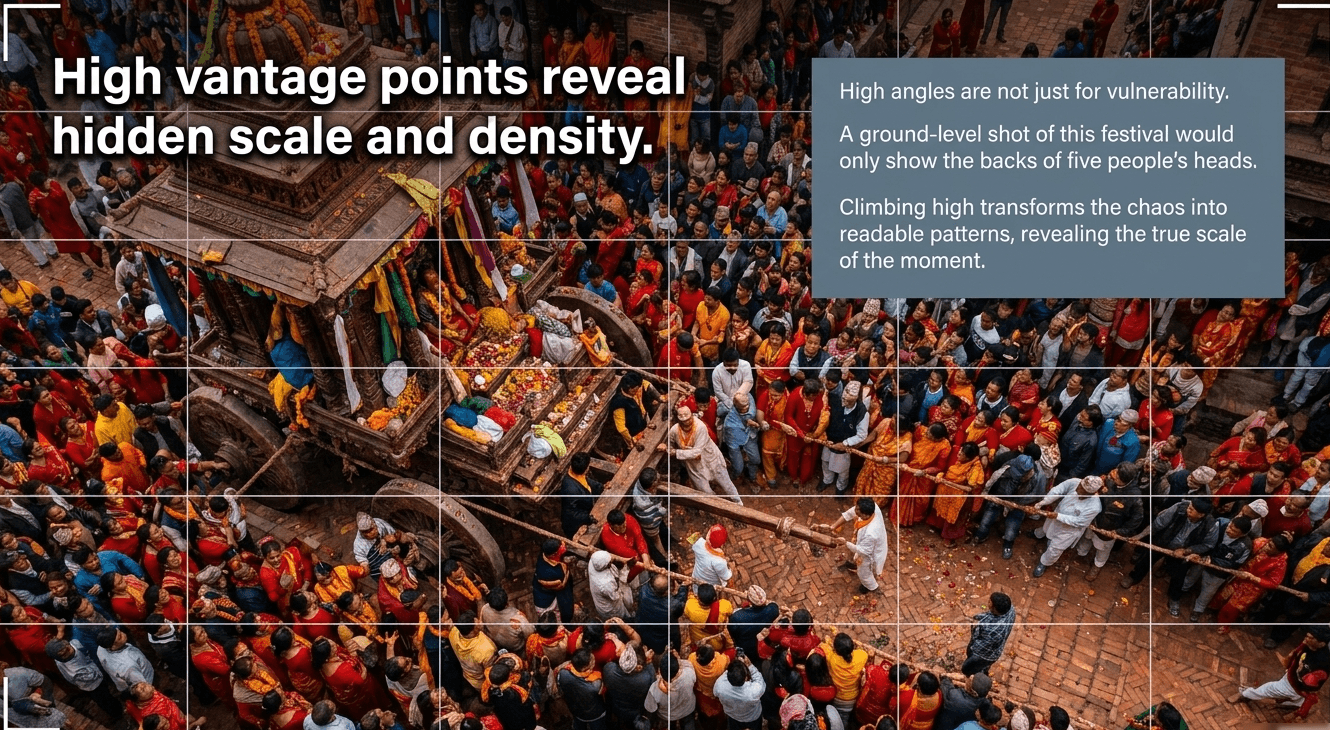
A high angle here serves an entirely different purpose than the isolation example above — it reveals the overall scale, pattern, and density of the crowd, information a ground-level shot simply couldn't show, since it's now more about context and scale than emotional vulnerability.
Angle also changes what's included in the background
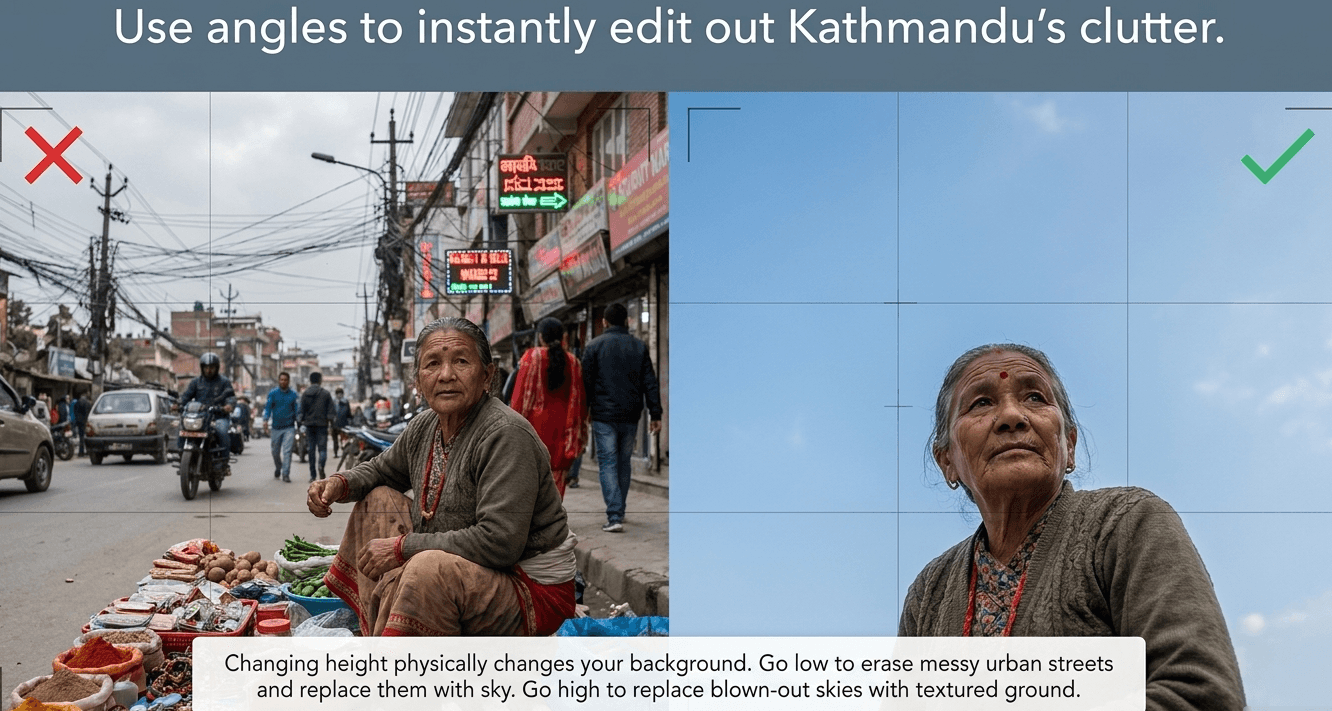
This connects back to earlier posts in this module: a low angle often clears distracting ground-level clutter out of the frame, replacing it with clean sky or ceiling — genuinely useful in busy urban settings like central Kathmandu, where a normal eye-level shot might be full of wires, signage, and passing traffic. A high angle, by contrast, often replaces sky with ground detail — patterns, textures, or context that only become visible from above.
Dutch angle: tilting the camera itself
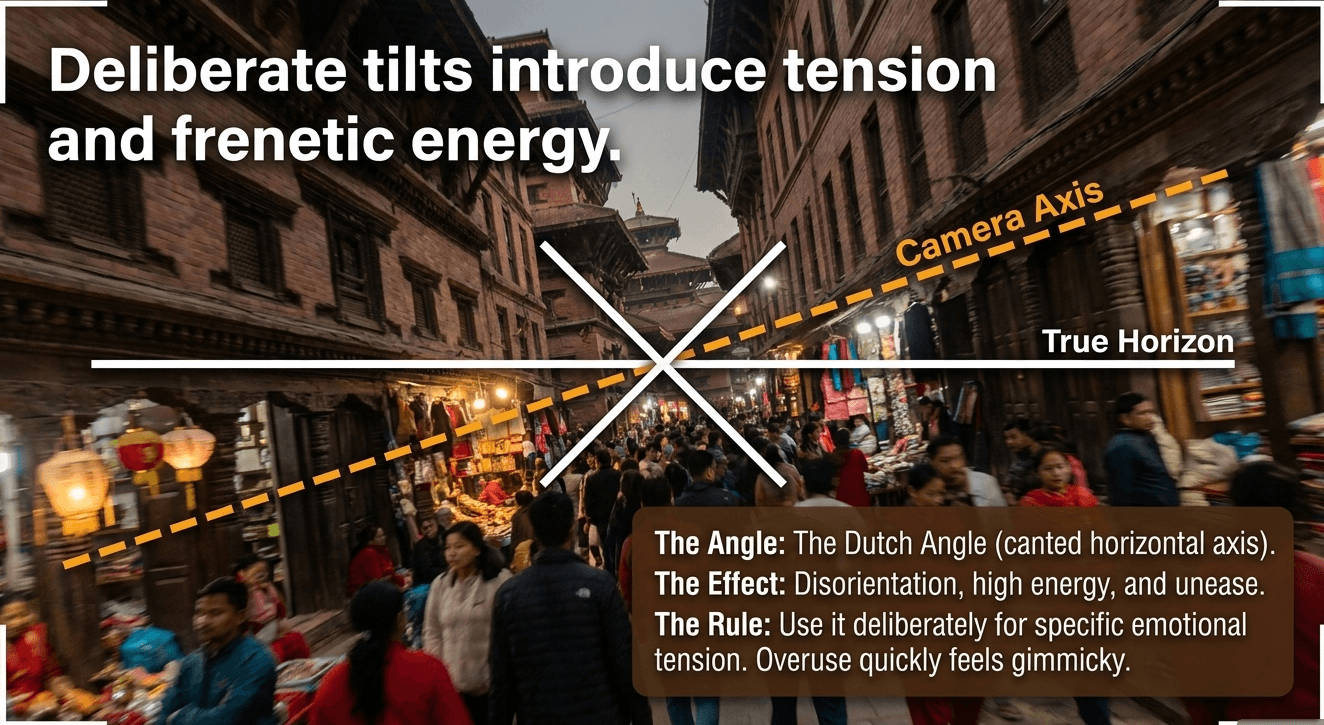
One more angle worth naming directly: the Dutch angle (or "canted angle") — deliberately tilting the camera off the horizontal axis, rather than changing its height. This creates a sense of unease, disorientation, or tension, and is used sparingly and deliberately — a slightly tilted shot of a crowded, chaotic marketplace can heighten a sense of energy or unease that a level horizon wouldn't convey. Overused, it quickly starts to feel gimmicky rather than intentional, so it's worth reaching for only when genuine disorientation or tension is the goal.
How to choose your angle: a quick decision guide
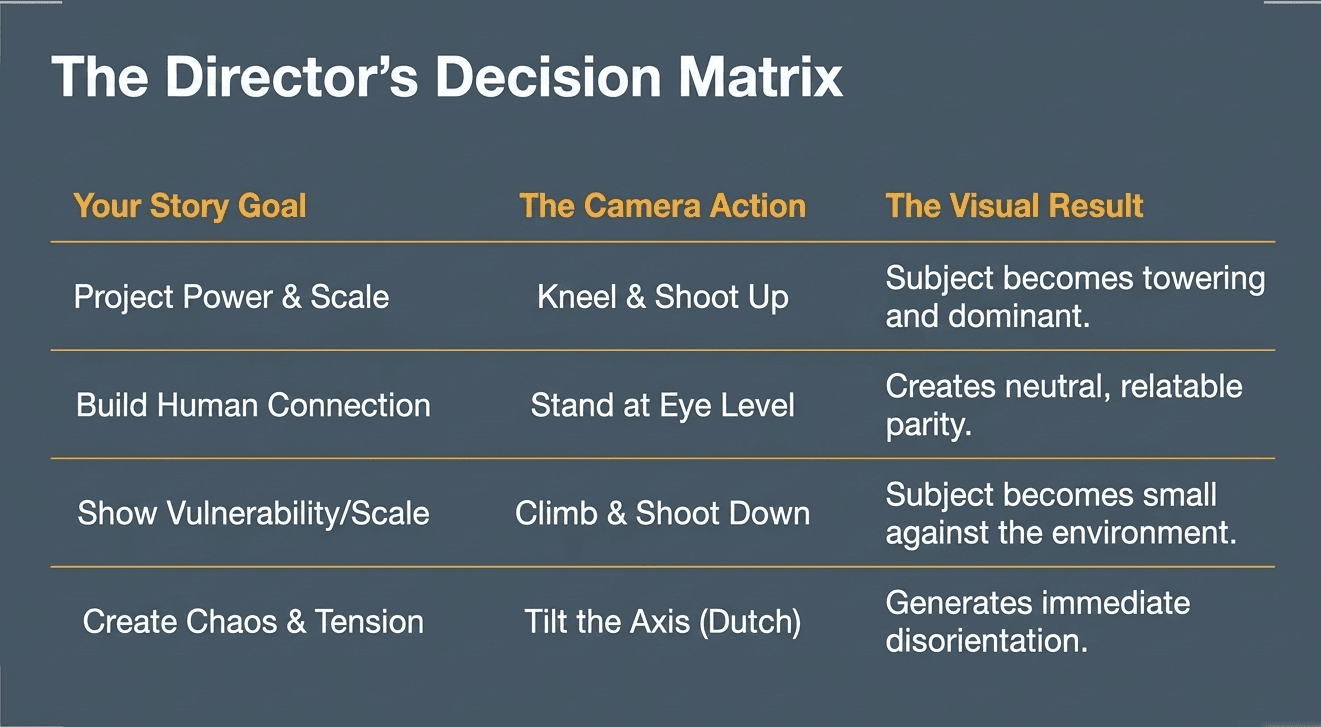
- Want the subject to feel powerful, confident, or monumental? Shoot from below, looking up
- Want the subject to feel relatable, natural, or equal to the viewer? Shoot at eye level
- Want the subject to feel small, vulnerable, or isolated — or want to reveal pattern and scale? Shoot from above, looking down
- Want a deliberate sense of tension or disorientation? Consider a Dutch angle, used sparingly
A common beginner mistake: never leaving chest height
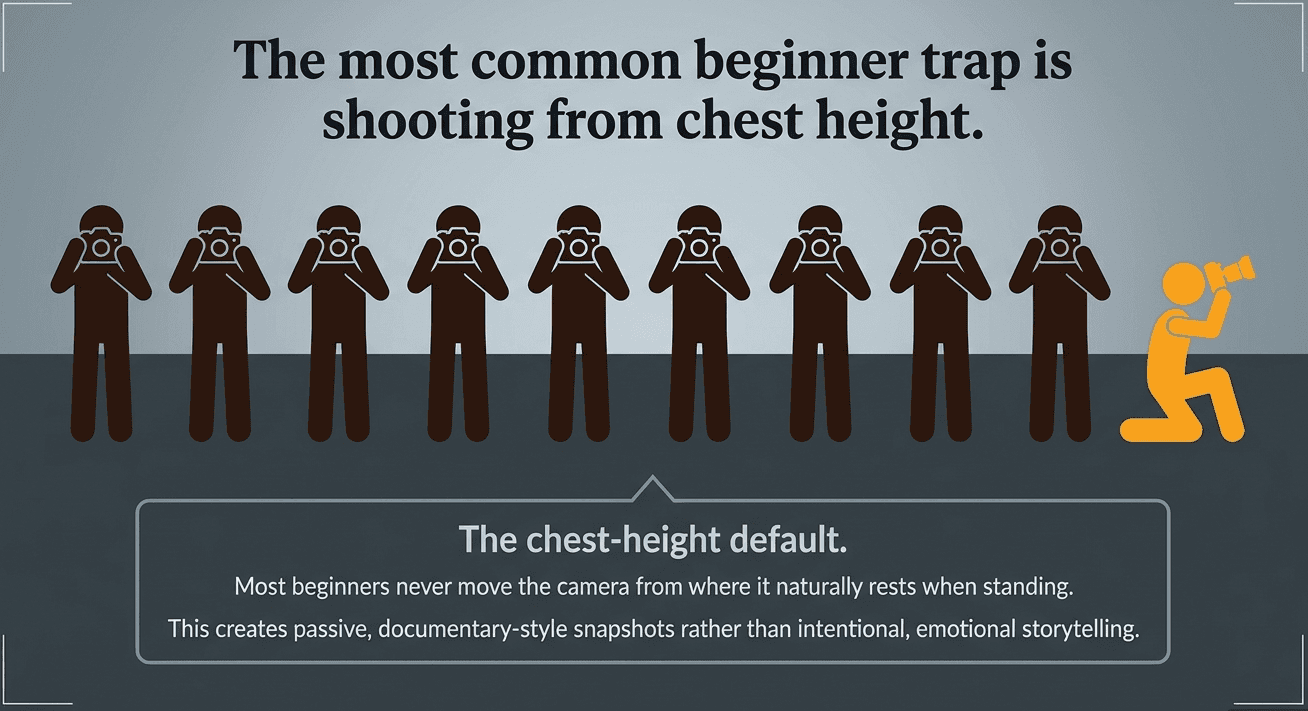
The single most common habit among new photographers is shooting everything from a standing adult's natural chest or eye height, simply because that's where the camera naturally sits without any extra effort. Crouching down, climbing to a higher vantage point, or even just kneeling changes a photo's entire emotional register — and it costs nothing except the small physical effort of moving.
A practice drill: one subject, three heights
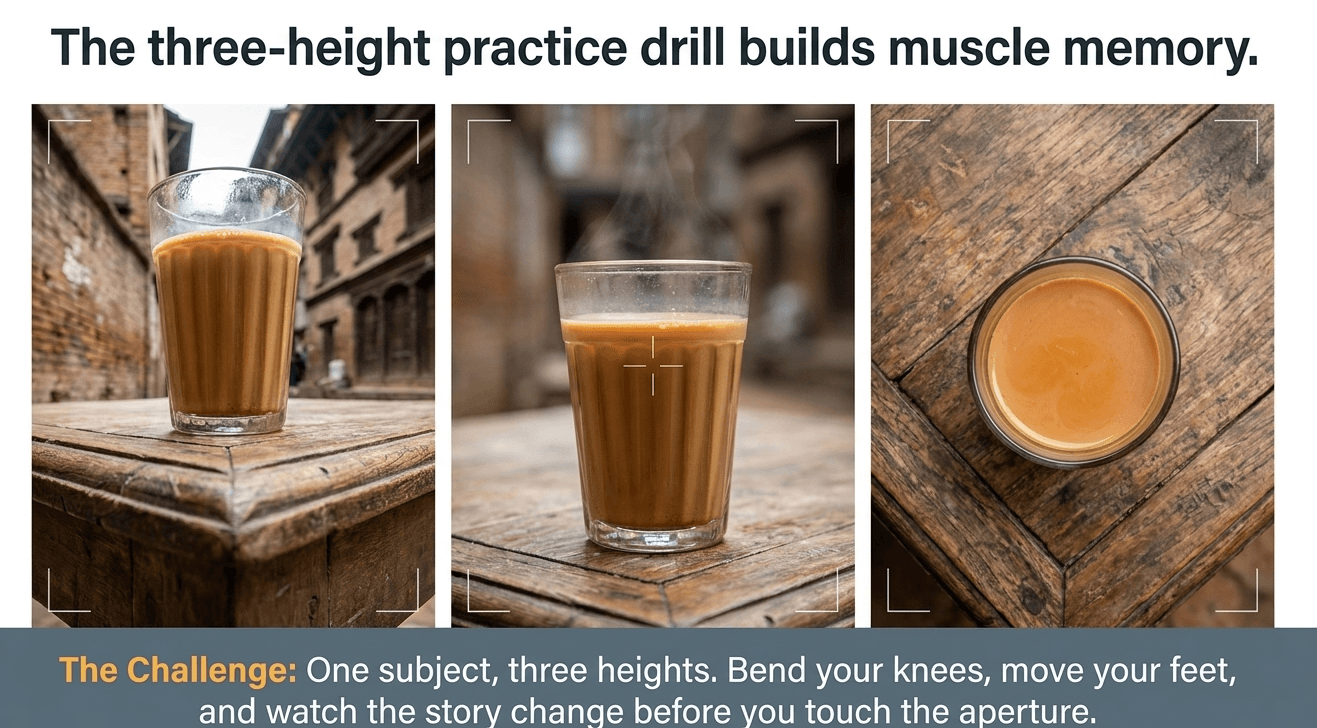
Photograph the same subject — a person, a building, an object — from three different heights: low, looking up; eye level, looking straight on; and high, looking down. Compare all three side by side. This is one of the fastest, most concrete ways to internalize just how much a physical camera position changes the emotional read of an identical subject.
Module 3 complete — here's what you've built
Across this module, you've moved from placing a subject well to genuinely directing how a viewer experiences a photo:
- Rule of thirds — placing subjects deliberately, off-center
- Leading lines, framing, symmetry — guiding the eye and using balance intentionally
- Negative space — giving a subject weight through emptiness
- Foreground, midground, background — creating real depth in a flat image
- Breaking composition rules — knowing when convention should give way to intent
- Perspective and angles — controlling the emotional relationship between viewer and subject
Next up: Module 4, Understanding Light — where we return to something we first touched on all the way back in Module 1, and go much deeper into golden hour, hard versus soft light, and working with both natural and artificial lighting setups.
Practice angle and perspective hands-on at Zyamaru Films Academy
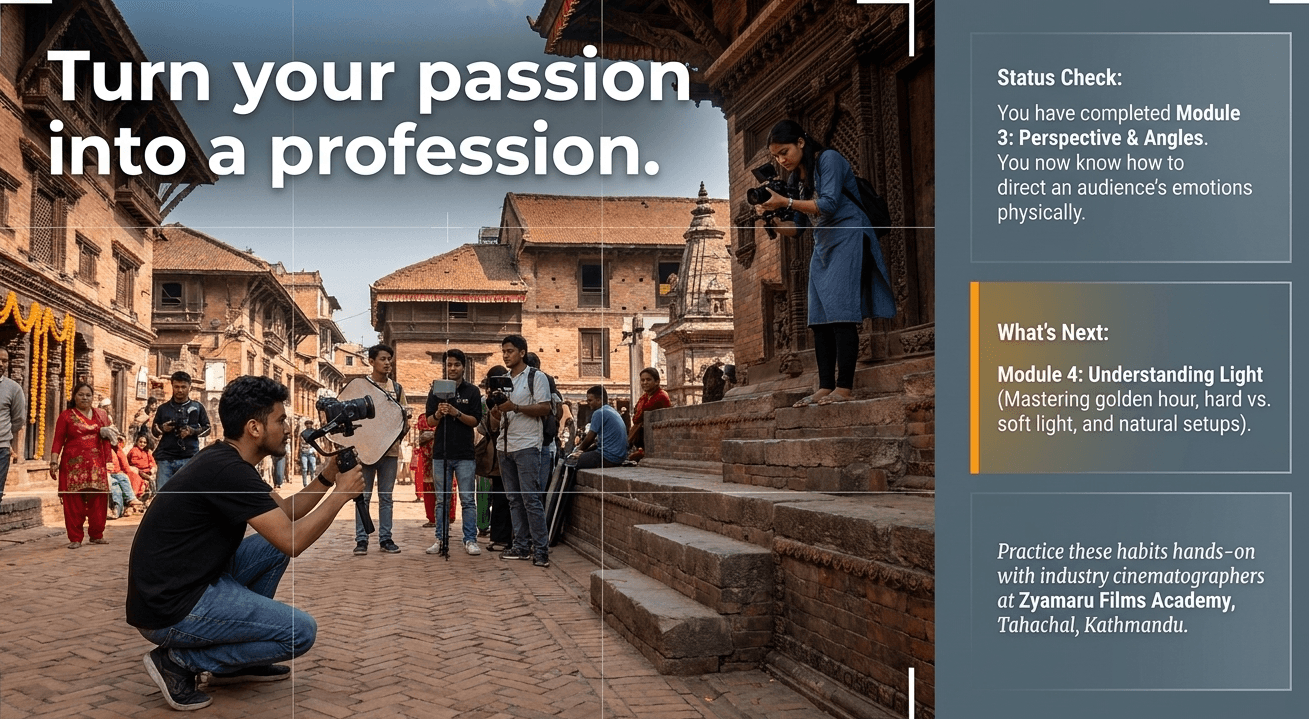
Physically moving — crouching, climbing, repositioning — for the right angle is a habit, not a theory, and it's one our instructors actively push students to build during location shoots. Our Basic Photography to Cinematography course at Zyamaru Films Academy in Tahachal, Kathmandu includes dedicated angle and perspective exercises across real locations, guided by an industry-active cinematographer.
Turn Passion Into Profession.
Frequently asked questions
What does a low angle shot do in photography?
A low angle, where the camera is positioned below the subject looking up, makes the subject appear larger, taller, and more dominant or powerful within the frame.
Why do photographers shoot portraits at eye level?
Eye level is the most neutral, natural-feeling perspective, mirroring real face-to-face interaction. It tends to create a sense of equality and connection between the subject and the viewer, which works well for most portrait and documentary photography.
What is a Dutch angle and when should I use it?
A Dutch angle is a deliberately tilted camera position, used sparingly to create a sense of tension, unease, or disorientation. It's most effective when used intentionally for a specific emotional reason, rather than as a default stylistic choice.